
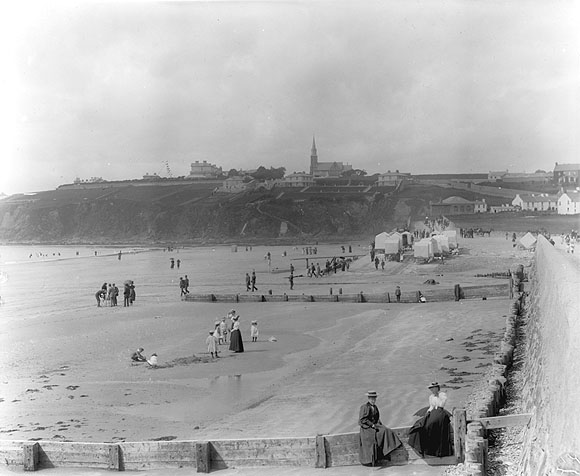
Tramore is a seaside town in the civil parish of Drumcannon, in the Barony of Middlethird in County Waterford. As well as the modern division of the townlands of Tramore East and Tramore West, the town also grew to encompass parts of the neighbouring townlands of Garrancrobally, Monloum, Ballycarnane, Coolnacoppoge and Newtown.
There is evidence of prehistoric settlement all around the vicinity of Tramore. From the Mesolithic shell middens in the Rabbit Burrows, a type of stone age rubbish dump to the megalithic tombs at Knockeen Gaulstown, Carriglong and Carrigavantry and the ringforts of Coolnacoppoge dating from the Neolithic and on through time to the Bronze and Iron Ages promontory forts of Westtown and further along the coast.
There are also the ruined churches at Drumcannon, Kilbride and Kilmacleague, the latter associated with Saint Deglan. Tramore, Gaelic, Trá Mhór translates as ‘The Great Strand’, a name conferred on it by the same Saint Deglan in the Middle Ages, according to the Gaelic scholar and first president of Ireland Douglas Hyde, in his ‘Ireland a Land of Saints and Sinners.’
In medieval times this area was intermittently ruled by the Uí Fáeláin and the Uí Bric septs up until their dispossession during the Anglo-Norman invasion and conquest of the late 12th century. From that time onwards it was part of ‘Power country’ ruled by the Anglo-Norman family of that name from their castles in nearby Dunhill, Kilmeaden, Cullencastle and Castletown.
 Tramore of Yore