

The New Waterford to Tramore Road was laid between 1832 and 1837, yet the section that now constitutes Turkey Road was not separately identified on the early 1840s Ordnance Survey map. This omission can be attributed to the absence of structures along its length, save for those situated at the intersections with Strand Street. Notably, O’Neil’s New Road Hotel occupied one corner, while the Bow Window House, constructed or refurbished by J W Maher in 1838, occupied the other. However, following the advent of the railway in 1853, the stretch between Strand Street and the newly built Strand Road became known in official records as the Railway Road, Station Road, or Terminus Road. Then in 1859, the Railway Road was referred to in print as Turkey Road, when J W Maher and John Joy petitioned a road sessions court sitting for the contract to keep it in repair for 5 years. The name gained regular currency thereafter, notably appearing in a newspaper account of a storm in October 1863, which detailed the need to dismantle fences along the road to facilitate the relocation of bathing boxes away from the encroaching tide.
The rationale behind the name Turkey Road remains uncertain. It might allude to the Crimean War, a time when numerous streets bore names related to the conflict—with some honoring battles like Alma and Balaclava, while others, such as Raglan Road in Ballsbridge, commemorated prominent figures such as Lord Raglan. However, it is improbable that the name pertains to the land of the Turks. The notion of naming it after Turkish baths is also unlikely, as Tramore did not witness the emergence of such therapeutic establishments until the 1890s. In England, one might find the occasional Turkey Road or Turkey Lane, yet their origins are generally attributed to mispronunciations of ancestral names or references to Turkey Trees, none of which were present along the Tramore road. A local court session in May 1866, when an individual sought clarity regarding the whereabouts of Turkey Road, revealed a curious explanation: it was termed so because a ‘present of turkeys’ was purportedly given to have run in that direction. Thus, it appears that the road derives its name from the now traditional centerpiece of the Christmas dinner. The custom of serving Christmas turkey had been entrenched in the British Empire since at least the mid-eighteenth century, and the port of Waterford was significantly engaged in the export of turkeys during that period.
Burrow House
The new railway didn’t immediately drive any new construction on the road itself although Marine Terrace was built shortly afterwards. While the New Road Hotel subsequently expanded along the road and underwent several name changes, first to Fry’s and then to the Hibernian. However, the first house to be built there was a detached three-bay, two-storey house known as Lima, previously named the Burrow House, the floorboards of which were laid by John Hayes in 1859. Curiously a man by the same name later served as the secretary of the Amalgamated Association of Carpenters and Joiners in Waterford City until his arrest for misappropriation of society funds in 1869. This house was rented out to visitors each summer for many years before it was put up for sale in 1913 under the directions of John McGurk. It was purchased by Mr. L. Breen, the proprietor of the Hibernian Hotel, for use as staff quarters and additional accommodations during peak periods. Tragically, a gas leak occurred in the building in July 1933, which led to the death of a young hotel employee.
Alexandra Place
Shortly after the completion of the Burrow House, Mr William Corbett, a Tramore boot and shoemaker begun the construction of the semidetached two story three bay houses that he was to name Alexandra Place, probably after Princess Alexandra of Denmark, the future Queen Alexandra. she was betrothed to Albert Edward, Prince of Wales in August 1862. The couple married the following year. On a festive note, I believe it was Albert’s father who first popularised the custom of indoor Christmas trees on these islands.
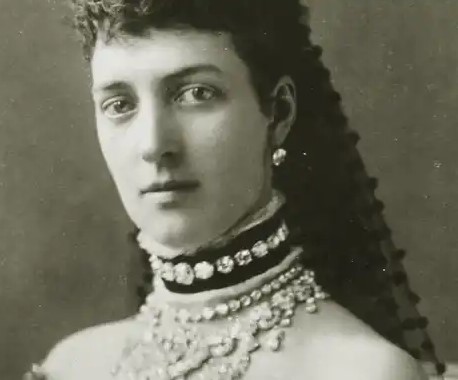
Nonetheless, Mr Patrick Dower Walsh, a Waterford merchant and auctioneer obtained possession of the building by way of a judgemental mortgage over a debt of £200 late in 1862. The use of a judgemental mortgage so soon after the construction of a building may have been the application of some legal loophole for the purpose of tax avoidance, as Walsh was already occupying part of the building at the time of the judgement. Walsh continued to occupy No.1 as a summer residence with a Miss Walsh and sometimes let it out to visitors, until he put the lease up for sale in 1869, which was then purchased by Mr Samuel Harris, a Waterford corn merchant for the sum of £150.
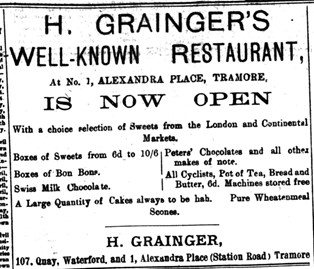
Henry and Emma Grainger opened a restaurant and confectionary shop at No. 1 Alexandra Place in 1897. Henry, a Kilkenny man died while still resident there in November 1911.
In November 1865 an auctioneer named Mr John Pender, who was probably an in law of Mr Walsh advertised No. 2 to let with a coach house and stabling for the winter months. He had an address at Little George’s Street in Waterford where he had a photographic studio. John lived in Tramore in the summer months with his wife Ellen and her sister Miss Margaret Walsh.
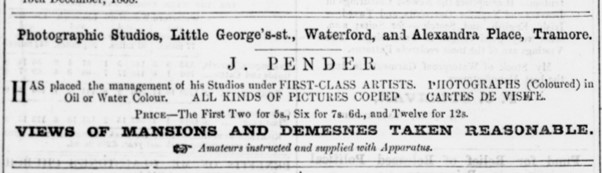
In 1869 Pender opened up a photographic studio in a part of the premises. In July 1884 the photographic studio was being run by a Mr Winter. While in August 1890 the Waterford Art Photographic Company took over that part of the premises. Sadly, John Pender died of influenza there in January 1892 at the age of 72. In his extraordinary generous will, he left the proceeds of the sale of two other houses No. 3 and 4 Tivoli Terrace to the poor of Waterford and Tramore. The two sisters continue to live in Alexandra Place until their deaths in 1893 and 95. Following which the interest in No. 2 was sold to Dr Joseph T White for £80. However, although White lived there until his death in March 1915, the very popular photographic studio was still run there in the summer months by a Mr Greiffeld between 1901 and 1908, until he moved the business to Strand Street.
Both Alexandra Place and The Burrow House are located in Tramore East and were on the property of the Doneraile estate. Whereas the next buildings to be constructed were in Tramore West and while this too was a part of the estate, it had been leased to Nicholas Power and his descendants for a term of 999 years.
Compsey Villa and Marine View
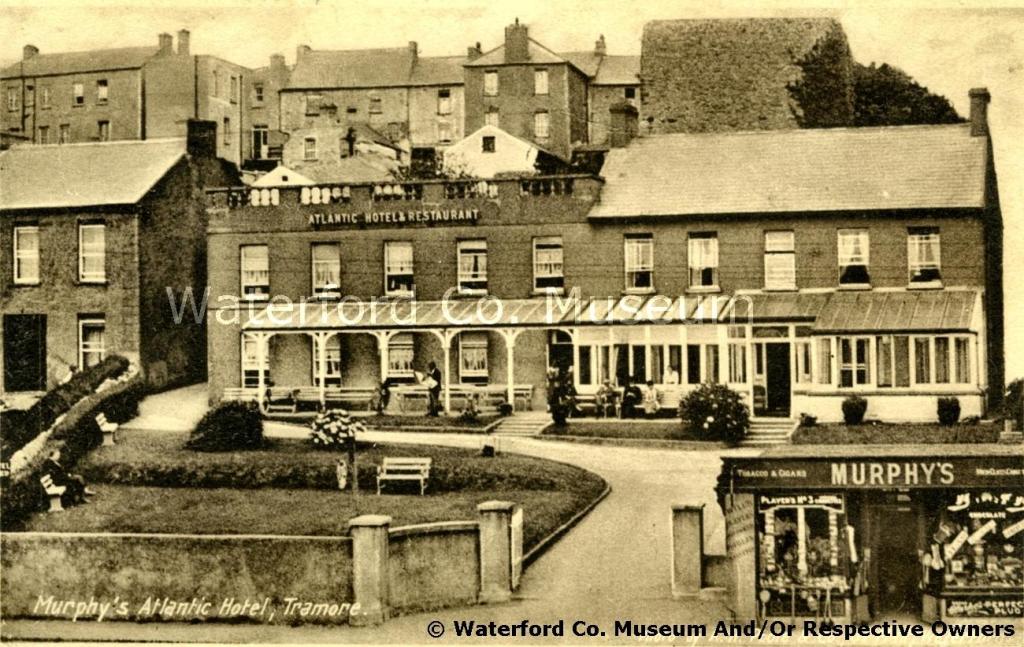
The structure formerly known as the Atlantic Hotel was originally named Compsey Villa. It was constructed shortly before 1870 and first emerged in newspaper listings of accommodations occupied by visitors to the town in 1871. The name may serve as a literary allusion, as Compsey Vale is referenced in ‘Knocknagow’, a novel by the Fenian writer Charles Kickham, published in 1873, which depicts various scenes set in Tramore. The property belonged to John Russell of Clonmel until his representatives offered it for sale in 1916. In January 1917, Mrs. Murphy, a prominent caterer, purchased the establishment, and the builder Mr. George Nolan executed significant alterations and additions before the premises reopened for the season under the new name ‘The Atlantic Hotel and Restaurant’. Mrs. Murphy had previously owned an establishment that bore her name on Strand Street. The building was later acquired by John Moore, a railway official who also owned Ocean View.
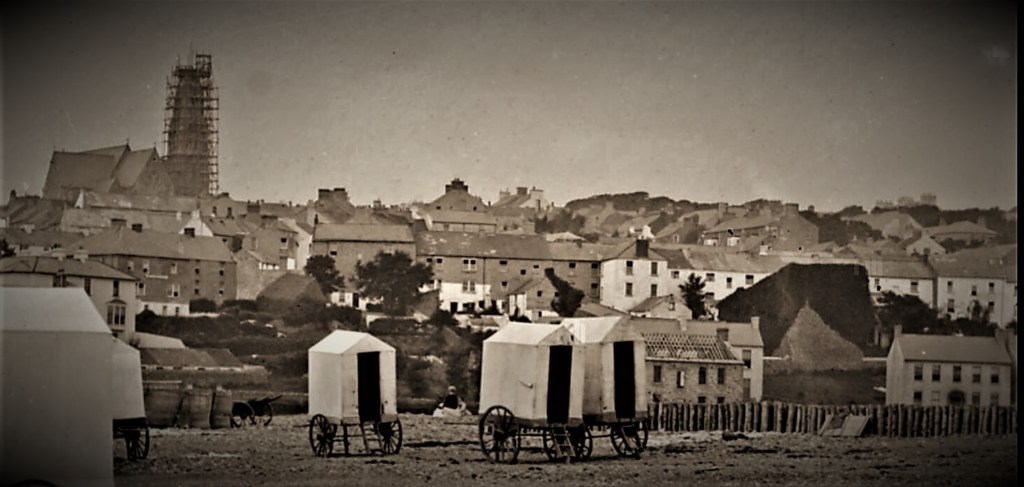
Marine View was constructed around the same period as the aforementioned houses. An intriguing photograph preserved in the National Library captures the construction of the Catholic Church Spire at the same time as the Seaview on Turkey Road in 1870, with Marine View and Compsey Villa to the rear flanking the Racquet Ball Court.
Following the passing of Captain John Read at his residence, No. 3, on 9 January 1892, the entirety of his household furnishings, including a cottage piano, were put up for auction. Subsequently, Mrs. Fleming of Church Road advertised the property for winter rental, marketing it as ‘comfortable lodgings for single gentlemen.’ This Margaret Fleming was a widow; her late husband, Michael, had been a sailor. She lived in Marine View with her son, John, until her death in October 1928. Among other residents were Mrs. Mary Murphy of the Victoria Hotel, who passed away at No. 1 Marine View in 1905, and Mrs. Hannah O’Dwyer, who resided at No. 2 until her death on 22 March 1907.
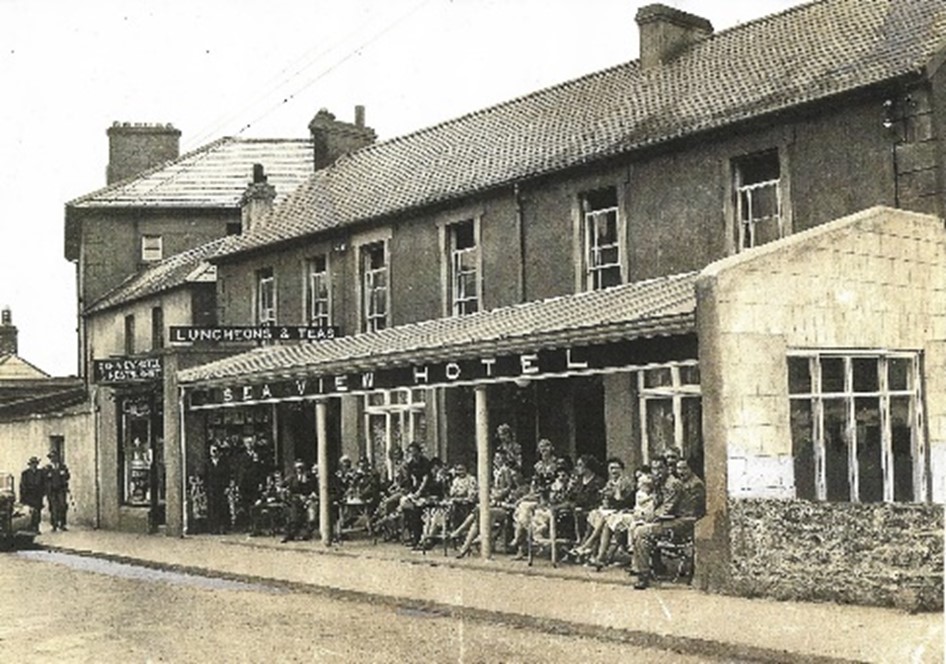
The Seaview Hotel and Terminus Villas
The Seaview Hotel was originally built as two separate houses in 1870, both owned by Ellen Phelan. However, Maria Wade soon acquired the property along with the newly built semi-detached houses known as Terminus Villas. Maria was born about 1829, the daughter of Thomas Wade and Jane Beynon of Kilkenny. Terminus Villas had been built by 1876, possibly by Mathew Hunt the first recorded occupant, on property leased from P W Power. Maria occupied one house there and let the other. She also leased the Seaview in its entirety to William McEvoy who ran it as lodging houses from the mid 1870’s until his death in 1900, when his business was taken over by his wife Mary and daughters Annie and Isobel. William had also been the proprietor of a toy shop on Strand Street. When Maria Wade died from heart failure in 1897, her niece Sophia Jane Ffennell of River House, Clonmel inherited the buildings. Although, the McEvoys continued to occupy the Seaview until Sophia sold it to Ellen Mary Kent in 1914. Annie McEvoy moved to No.1 Turret Place where she lived until she passed away in 1939.
Ellen Mary Kent was the sister of Anastasia Doran, the manager of The Marine Hotel next door. Ellen announced the opening of the Seaview Private Hotel and Restaurant on 16 April 1915. Ellen was a widow having been married for less than two years when her husband Robert S Kent died in 1911. Prior to her marriage, she was the proprietress of a confectionary shop at 110 The Quay, Waterford. The Seaview was advertised as a going concern under Mrs Kent on 18 June 1920 and again on 27 May 1921. Mrs Mary Anne Ryan, who was once a barmaid in a O’Meara’s Hotel on Bridge Street in Waterford bought a lease to the hotel in 1924-25. However, Mrs Ryan didn’t remain in business there very long and in 1928 the Seaview Hotel was sold to Patrick and Rita Fitzgerald, the proprietors of Saint David’s Private Hotel and Restaurant, on Main Street. Rita had worked previously worked under Mrs Kent in the establishment some years before.
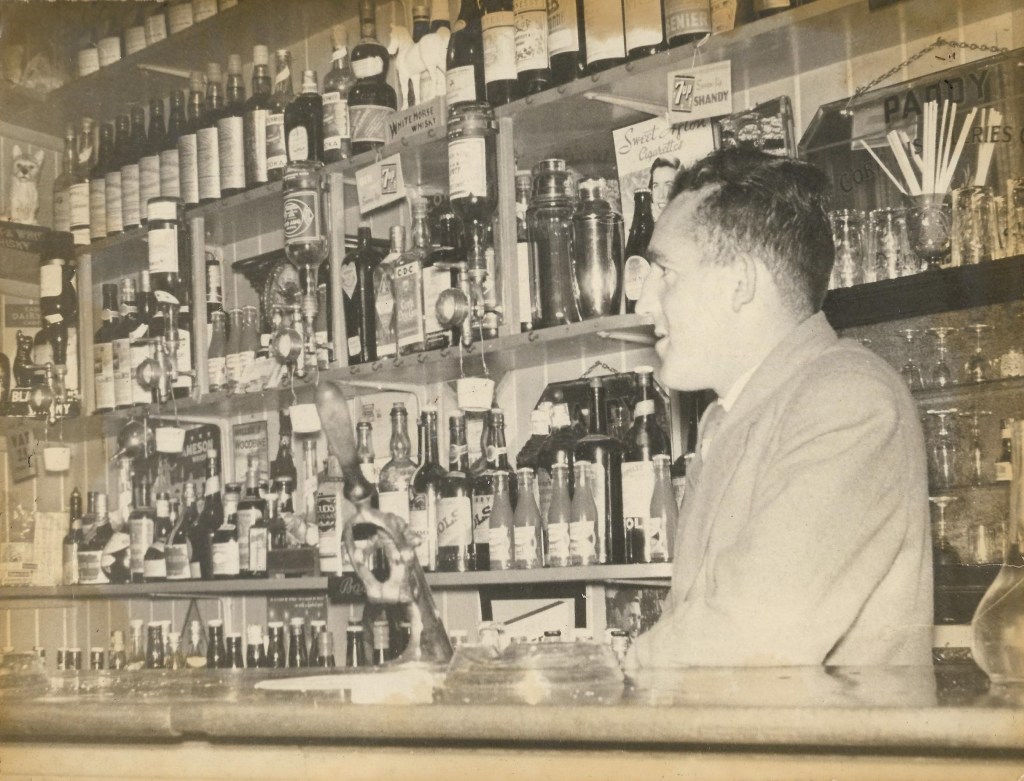
The hotel stayed in the Fitzgerald family for sixty-six years until it was sold in 1994. In fact, its last owner was known to all who knew him as ‘Johnny Seaview’.
The Merrion Hotel
The building that is now called Beach House was built after 1870. The Merrion Hotel was run by Bridget M Ryan from about 1910. She was a Tipperary woman born about 1867. Bridget married Jame Hayes a widower with a large family from Tipperary around 1917, his first wife having died a couple of years earlier in 1915. Unfortunately, Bridget died in the hotel about six years later in 1923. Subsequently, having inherited the hotel, he married a widow named Margaret Power. Margaret had been previously married to Paul Power of Kilbride who died shortly after the end of WWI. She was the daughter of Lieutenant Alfred Nevett, who lived across the road from the hotel in Terminus Villas. The Cashmans, a Wexford family lived here in the 1970’s, before it became a restaurant named the Pine Rooms which served a good prawn cocktail.
Lyon Terrace
Lyon Terrace was constructed by Mr. Robert Lyons of Tramore in the late 1870s. Mr. Lyons operated a prosperous bakery business on Main Street, a legacy continued from his father. In August 1879, the Waterford and Tramore Railway Company initiated legal proceedings to recover nearly £5 in freight charges for goods transported on Mr. Lyons’ behalf. Since March 1878, over 2,000 bricks, along with timber and lime, had been transported via the railway without full payment. A deed was proposed as evidence, stipulating that Mr. P. W. Power and his tenants would be permitted to transport building materials on the line under specific conditions. However, the plaintiffs argued that these conditions had not been met in Mr. Lyons’ situation. The case was initially adjourned until the judge determined that Mr. Lyons had not satisfied the terms of the contract required to qualify for reduced rates and thus was liable for the amount of £3 15s. Nevertheless, when completed the three houses of Lyon Terrace were assessed at £19 per annum each in the valuation records of the 1880s. Major George W Maunsell, a retired officer of the 106th Regiment of Foot who had served in India for many years was one of the first recorded occupants on the terrace. William Lyons, probably Robert’s son, put his interest in No. 3 up for sale in 1897, when it was purchased by a Mrs Moore for 480 Guineas. Mrs Moore also held the lease to one of the houses of Terminus Villas. I believe this became the Marymount Private Hotel which was advertised in June 1912, as overlooking the sea, near the train station and offering good cooking and attendance.
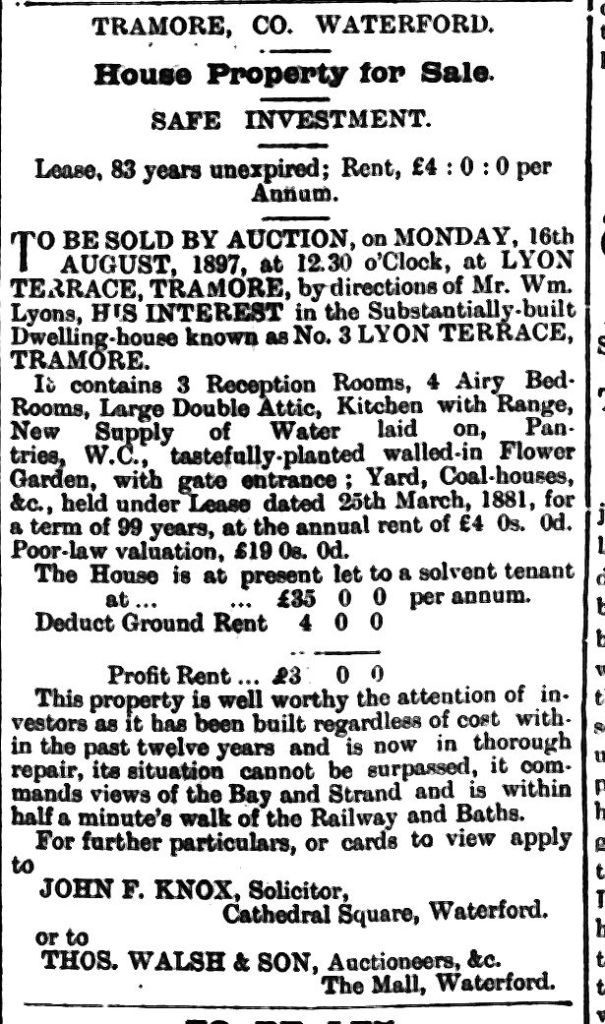
Another resident of the terrace was Mr John O’Shaughnessy who operated a lodging house out of No.1 from 1902. His daughter, Mrs Bridget Keane later opened a nursing home on the premises. St Martha’s was registered with the Department of Health as a maternity home in November 1947. It was described as a fully equipped ‘modern nursing home’ with space for a limited number of maternity patients. The phone number was ‘72’. A year later, on the morning of Tuesday 16 November 1948 Bridget married a fellow by the name of Patrick Dwan of Templemore in the Holy Cross church. The wedding breakfast at which fifty guests were present was held across the road in the Seaview Hotel. There were many births in St Martha’s reported by happy parents in the local newspapers over the following years. Sadly, Bridget died at the age of 54 in the County and City Infirmary on 4 August 1960. The property was put up for auction shortly afterwards on 5 April 1961.
The Marine Hotel
The Weston Marine Hotel was built by 1883. In that year Ms K Flynn advertised that it was open for business and had two entrances one opposite the Railway station and the other on Alexandra Place. This is interesting as several of the valuation books list the Seaview Hotel as being on Alexandra place as well. In July of the same year a meeting was held there in which it was decided to hold races on the new flying course at the Back Strand on 13 and 14 August, with stakes to the amount of £450 being offered.
In October 1885 it was advertised in the Waterford News as a First-Class Hotel, beautifully situated, commanding an uninterrupted view of the bay, and within one minute’s walk of the strand and railway station. As with most hotels and guest houses, special terms were offered for boarders. K. Flynn was the sister of Reverend Flynn, parish priest of Trinity Without and Butlerstown. The 1901 Census still shows her to be the Proprietor of the hotel. In fact, Miss Flynn ran the hotel for nearly twenty years until her death in February 1902 when it put up for sale. The selling price was £1300 and in May 1902 the license was transferred to the new owner Mr. Robert Costello.
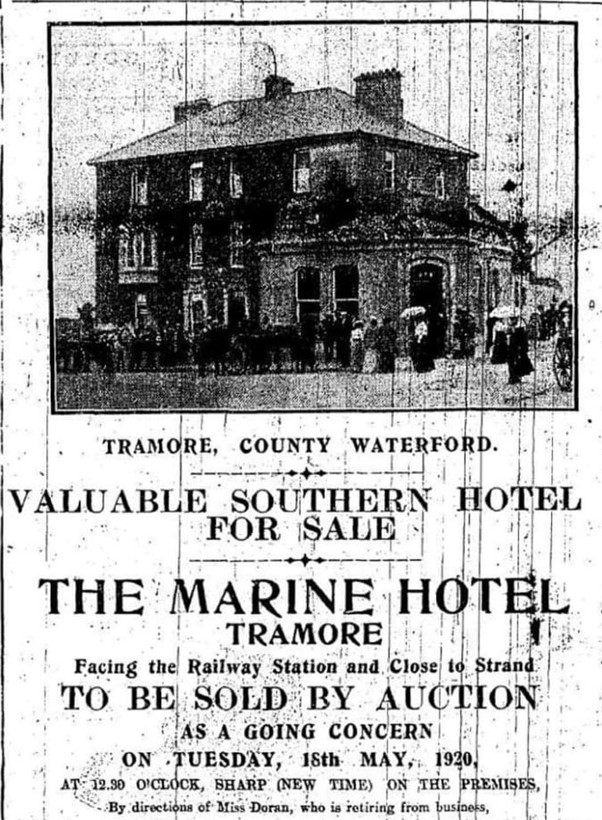
Robert Costello was a Sanitary Engineer and is listed in Thom’s Directory 1909-10 as having his address here. He oversaw several improvements in the building, when it was greatly extended in the years 1901-1911. The new manager of the hotel was a woman from County Meath by the name of Miss Anastasia M Doran. She was a relative of the publican James Mulligan, owner of the famous ‘Mulligan’s of Poolbeg Street’ in Dublin. The Marine Hotel was put up for sale in May 1920, under the direction of Miss Doran who was ‘retiring from business’. The advertisement for its sale mentions ‘Perfect Sanitation’. The hotel was later owned by the O’Sullivans for many years.
Palace Square
Both Palace Square and King’s Court always had laneways leading onto Turkey Road. However, prior to later construction the Palace Yard which faced Turkey Road was sometimes rented out to travelling showmen. In the Summer of 1893 Mr Edwards, a ‘prizegiver’ had a legal dispute with the owner of the yard Joseph O’Brien, the proprietor of both The Palace Square Hotel and the Summerhill Hotel. It appears that Edwards hired the yard for a month. However, O’Brien took offence to the nature of Edwards’ show and reneged on their contract and told him to ‘clear out’. This Edwards refused to do and O’Brien then locked the gates leading into the yard. Mr Edwards then had two ladders placed against the railing of the yard and the place was soon full of people, ‘who thoroughly enjoyed the wordy war going on.’ Ultimately, the lock on the gate was broken, prompting both parties to seek legal counsel.
The houses now occupying either side of the Palace Square entrance were only built in the first years of the 20th century. The house known as Swindon, previously occupied by the Flemings was built circa 1900. It has been derelict for many years. The single-story house at the Palace Square entrance that used to be named The Chalet was built around 1900 and was owned by Mrs O’Brien of Palace Square who let it out to visitors. In October 1910 the entire household furniture of the building was put up for auction. Shortly after which, 19 years old newlyweds Maurice Quinlan, a cattle dealer and his wife moved in. The couple had a son Mossie Quilann who born there in March of that year, the month before the 1911 Census was taken. When he grew up Mossie became a member of the Irish republican socialist umbrella group known as the Republican Congress and later joined the British International Brigade in which he died fighting the fascists in Spanish Civil War. However, I don’t think that the little family could have lived there very long as Lieutenant Alfred Nevett, Royal Navy, an ex-Chief Battery Officer of the Coastguard in Tramore moved in there later in the same year. His wife Mary died there in October 1919. The building accommodated Paddy Power bookmakers in the 1970’s and 80’s.
Piper’s Field
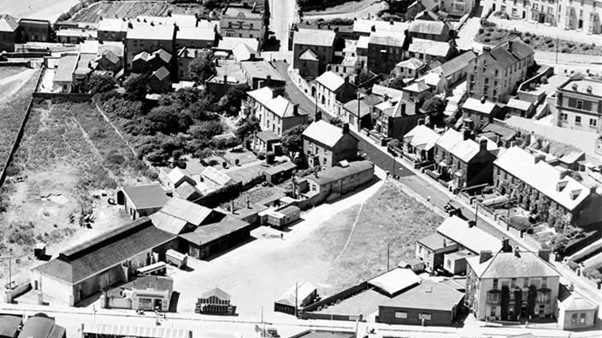
One of the most important features of Turkey Road wasn’t a building at all, but a field. The field between The Seaview and the Merrion Hotel came to be known as Piper’s Field, presumably after Mr William C Piper. A notice appeared in the Waterford Evening News in August 1913 appealing for the return of a lady’s gold watch that was lost between that hotel and the baths. The finder would be rewarded by returning the watch to ‘Miss Ryan, Merrion Private Hotel (next Piper’s Field)’. Unfortunately, Mr Piper died in the following year and two years later his widow Emily leased the property from Edward N Power. The valuation books of the 1930’s and 40’s record an amusement arcade on the property run by David Barry, two bungalows occupied by George and Freddie Piper and a shop run by Philip Fox. There had also been a cinema there. While the valuation books list these properties on Railway Road, they mainly face onto Strand Road. Nonetheless, one particular story is relevant to the present article. On 3 July 1959, Bridget Dwan petitioned the Waterford Circuit Court for an injunction to prevent Frederick Piper from causing a disturbance through noise in the field. Mr. Piper operated an amusement arcade featuring a pongo booth that operated nightly, along with a set of swing boats illuminated by coloured electric bulbs, powered by a tractor in the field. Mrs. Dwan asserted that this noise posed a threat to her business as a nursing home. The defence contended that a nuisance would only be recognised if it disrupted the comfort of local residents and argued that the area was “quite clearly not suitable for a nursing home.” Piper’s Field was described as being the very heart of the tourist traffic for the town of Tramore. The judge declined to issue an injunction and chose to adjourn the hearing.


 Tramore of Yore
Leave a comment