

The following is a list of shipwrecks and close calls in and around Tramore Bay in the first two decades of the Nineteenth Century. It can be hard to comprehend just how common shipwrecks were in this period. It has been estimated that some 2000 wrecks occurred world wide every year between 1793-1815. While, Sir G J Dalyell, a contemporary authority, writing in England in 1812, claimed that ‘perhaps not less than five thousand natives of these islands yearly perish at sea.’
- The Alexandria & The Columbine, January 1800. Cork 1 February 1800: The Alexandria transport, Lieutenant Elsmere, and the Columbine transport, Captain Haddleston on their passage from Embden to Dublin which put into our harbour from whence they sailed last Saturday morning, in consequence of thick weather, mistook Tramore Bay for the entrance to Waterford Harbour. The Columbine came to an anchor inside Brownstown Head and when the tide offered, cut her cables, got over the bar most fortunately and ran up Rhine-Shark Harbour, where she now lies safe. The Alexandria, missing her straps, was obliged to anchor close in with the breakers, where she remained till Sunday night, near high water, when she also cut her cables and run well up on the beach of Tramore. Should the weather continue favourable, it is thought she will be got off. These are the vessels which conveyed from New Geneva the United Irishmen for the King of Prussia’s service.1 For the imprisoned United Irishmen, it was a case of enlist in the Prussian army or spend years in penal servitude in the colonies, although it is doubtful that were given a choice. About 400 were of them were sent to Prussia and rather than serve in the army, many of them ended up working and dying in the king’s salt mines.
2. An Unknown Transport, 3 November 1801. A Transport was lost on the night of the 3rd inst. in Tramore Bay, with paid off seamen, 300 of which were drowned.2 This is probably an error in reporting, as while the statement is repeated in several newspapers, it is not elaborated on, as would be expected for a disaster of this magnitude, nor is it mentioned in the relevant secondary sources.
2. The Harmony, January 1802. The Harmony, Baird, of and from Philadelphia, with flax seed, is on the shore at Tramore, in Ireland.3
3. The Mary, January 1802. Monday night the sloop Mary of Cork, Captain Verling, was stranded at Tramore, but without having received any damage. And we are happy to hear, no doubts are being entertained of her being got off.4
4. The Mona: 29 December 1802. The Mona, J Foulks master, was a three masted, square rigged ship of 317 tons burden; with a draught of water of 13 ft. when loaded. She was built on the River Thames in 1787 and sheathed with copper in 1801, owned by Penny & C. She held an A1 classification and was last described as a constant trader between Liverpool and Africa.5
The Mona, Foulkes, from Jamaica to Liverpool, is totally lost off Bonmahon, near Waterford, crew saved. Part of the Dollars and some bales of cotton saved.6 Cork, 3 January, On Wednesday morning last in a gale of wind, the ship Mona, Captain Foulkes, laden with sugars, coffee, cocoa &c. and bound from Kingston to Liverpool was lost off Bonmahon strand, together with nearly her entire cargo-crew saved.7
5. The Diligence, Saturday 7 January 1804. The Diligence, Captain Gorman, Cork for Waterford, laden with staves & c., sprung a leak at Tramore on Saturday night. The captain ran her ashore in the bay. The crew and cargo are safe.8
6. The Telemachus, February 1804. The Telemachus was a three masted, square rigged ship of 204 tons burden, single decked with beams, with a draught of water of 12 ft. when loaded and armed with two 4 pounder cannon. She was foreign built, owned by Power & C, and classified as E1. She was a regular trader between London and Honduras and had good repairs done in 1802.9
The Telemachus, Swan from London to Honduras is put into Tramore Bay, near Waterford, with much damage.10
7. The Little Charles, May 1804. About four o’clock on Thursday evening, the brig Little Charles, of Liverpool, Alex. Keating master, bound from Liverpool to St. Michael’s, in ballast, struck on Fileskirt Rock, off Ballymacaw, Ireland, and immediately sunk. The crew were fortunately saved.11
8. The Charlotte & Ann, October 1804. Waterford October 30, On Friday last, the sloop, Charlotte and Ann, McKirdy, master, from Liverpool to Galway, with salt, was driven on shore at the Lady’s Cave, Tramore Bay, and soon after went to pieces, crew saved.12
9. The Sampson, 11 March, 1805. The Sampson was a Spanish prize, captured by the Melpomene frigate, while sailing from Havana with a cargo of rum, sugar and cotton that was wrecked at Annstown on 11 March 1805.13 The Spanish vessel, the Sampson, which stranded at Annstown, has become a mere wreck. Vast quantities of rum and brandy have been lost or destroyed. One countryman unfortunately died from drinking those spirits to excess.14
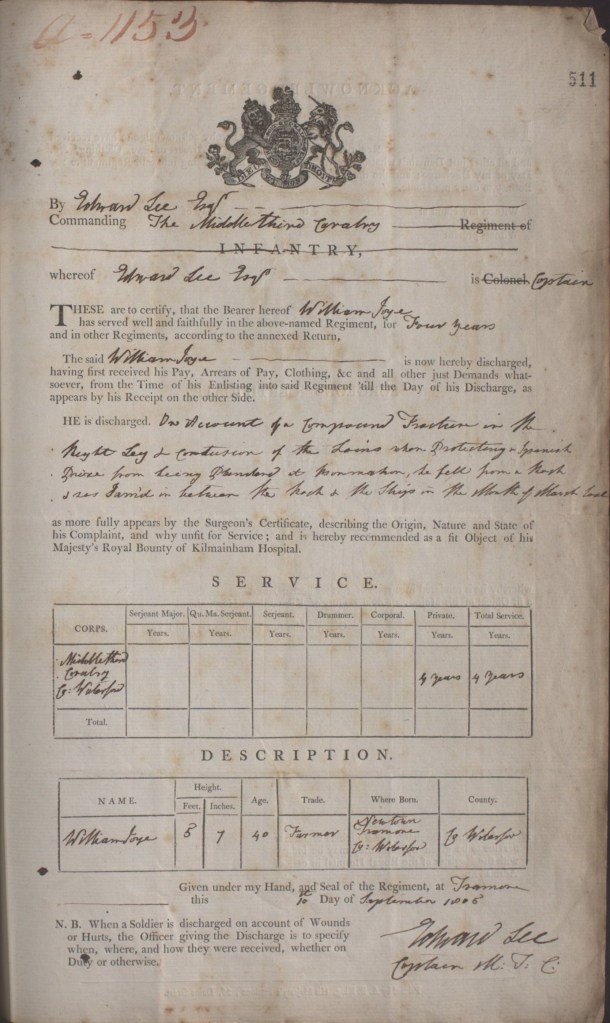
Edward Lee of Tramore Lodge was captain of the Middlethird Cavalry at the time, when one of his men, William Joye, a farmer from Newtown, was injured in the incident. William, aged 40, stood 5ft 7” tall. He was discharged on account of a compound fracture in the right leg & contusion of the loins when protecting a Spanish prize from being plundered at Bonmahon, fell from a rock and was jammed in between the rock and the ship in the month of March last. The discharge was witnessed by Lee on 10 September 1805. 15
10. The Cheshire, 21 November 1806. The Cheshire, J Roach master was a single decked brig of 63 tons, with a draught of water of 12 ft. when loaded, built in Bridgewater in 1785. She was part rebuilt in 1806 when a new deck was added. She had an E1 classification and was described as a constant trader between Liverpool and Cork.15 Liverpool, Nov. 13. The Cheshire, Roche, of this port, from Newport to Cork with coals, was driven on shore, dismasted, in Tramore Bay, near Waterford, on the on 21 inst., crew saved.16
11. The George & Ann, February 1806. The George & Ann, was a single decked sloop of 95 tons burden, with a draught of water of 17 ft. when loaded. Built in Ringhorn in 1801, owned by Cater & Co, she was last described as a Dublin Coaster, and held an A1 classification.17 On Tuesday se’nnight, the George and Ann, of and from Liverpool, Thomas Stephens, master, was stranded at Bonmahon, in the Co Waterford. The crew saved, but the vessel & cargo, it is feared, will be lost.18
12. An Unknown Wreck at Annstown, November 1806. During the late gales, some vessels have been lost to the westward; as we have been informed that a rudder, some casks, and a quantity dry fish have been thrown on the Strand of Tramore. Monday week, a wine cask, with the head beat out, ashore at Annestown, from which it is feared that some vessel has been wrecked on that part of the coast.19
13. The Trusty, January 1809. The ship Trusty, a West Indiaman, Master James White, from Bristol to Tobago was totally wrecked on 17 January 1809 on the Brazen Head Rock, off Brownstown Head, at the entrance to Tramore Bay. Only 7 people out of 23 on board were saved: We regret to state that on Tuesday evening between two and three o’clock, the ship Trusting, of about 350 tons, James White, master, of and from Bristol, for Cork to join convoy, and from thence to proceed to Tobago, struck on a rock called the Brazen head, near the signal tower, off Brownstown, where she went to pieces in less than half an hour, and out of her crew of 21, and two passengers, only seven persons were saved, viz.-John Liston, first mate, William Gardner, second mate, Mathew Engleholm, carpenter, William Lewis, cook, John Gleeson, seaman, George Wesley, apprentice, and Peter Savage, seaman. The two passengers were Master and Miss Smith, of Tobago, who had been sent to England for the purpose of being educated, and were on their return to their parents. Great praise is justly due to Michael Kennedy Esq. for his humanity to the survivors and his unremitting endeavours to save as much of the cargo as possible, which consisted of dry goods, earthenware, &c. Nor should the promptitude with which Lieutenant E Thraskon, of the single tower, lent his assistance, go unnoticed.20
The Trusty was actually registered as a ship of 306 tons burden, with a draught of water of 17 ft., when loaded. Built in 1790 in Bristol, she was owned by a Mr Daniel and held an E1 classification in 1809.Captain White, born c 1766, was an experienced mariner, having captained the ship since 1800, when he was aged 34; he made several journeys to Demerara and Barbados in the ensuing years. In his obituary, written in Cirencester, Gloucestershire, the cause of the wreck was said to be as a consequence of the pilot mistaking Tramore Bay for the entrance to Cork Harbour in the dark. During the whole time of impending destruction, Mr White remained perfectly calm, employed in encouraging the crew, and preparing means for their preservation. Though an excellent swimmer, he would not attempt to escape by himself, nor quit a boy, who was a passenger, and clung closely to him. He was a man of great integrity and firmness of mind, united with the kindest affections, and with a strong sense of religion, of the rational and cheerful kind; qualities that rendered him respected by all who knew him.
Captain White was aged 43 at the time of the wreck. He was buried in Drumcannon graveyard, the funeral service being performed by Reverend John Cooke on 22 January. The burials of the other victims were not recorded in the Drumcannon parish register. Interestingly, a memorial stone was erected for Captain White in the churchyard at Stradbally, the inscription on which reads: Sacred to the Memory of Captain JAMES WHITE Master of the Ship Trusty of Bristol Wrecked on this Coast January 29th 1809. The stone includes an epitaph extolling his virtues as an affectionate and faithful husband, tender and sincere father. The stone now lies flat but appears to have been originally placed in an upright position. Considering that the inscription records an incorrect date of death, I would think that the stone was placed in Stradbally some considerable time after the event, due to an error of some sort. Who knows, perhaps it was originally intended for Tramore?
14. The Appledore, January 1809. The sloop, Appledore, of Barnstable was stranded in Tramore Bay on the same evening, but was later salvaged. The sloop Appledore of Barnstable was stranded in Tramore Bay 17 inst.21
15. The Caledonia, 27 January 1809. The Caledonia was a brig, with a 177 ton burden, two decks and a draught of water of 12 ft., when loaded; built in Ayr in 1805, owned by Buchannan. She held an A1 classification and was described as a constant trader between Greenock and North Providence.22 The brig Caledonia, of Glasgow, John Stewart, Master, bound from Alicant for Belfast, drove into Tramore Bay on Friday night, between 8 and 9 o’clock. The crew, 14 in number, have all been saved; but it is apprehended the vessel will go to pieces. She has on board 500 bales of Barilla, (a kind of Spanish alkaline salt, used in the glass and linen trade) 530 bundles of cane reeds, and twelve bags of nuts and almonds.23
16. La Sainte Anne De Livourne, 26 October 1809. La Sainte Anne De Livourne, was sailing from Leghorn (modern Livorno) carrying a cargo of wine when she was wrecked at Rhineshark Harbour.
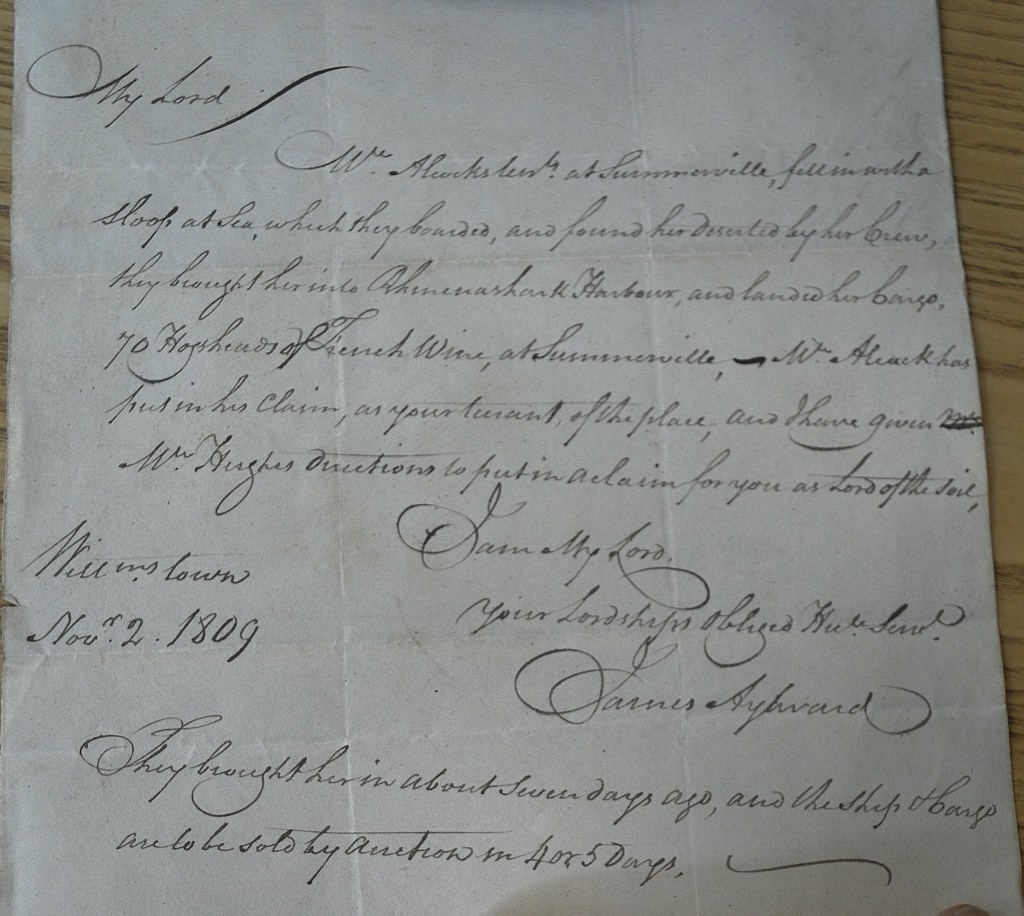
On Thursday, the boatmen, who ply in the neighbourhood of Ballymacaw and Brownstown, discovered at some distance at sea a small cutter. On approaching her, they found her totally deserted, lying on her side, and nearly sinking. Having towed her into Rineshark, they found on board 67 hogsheads of claret, a small quantity of white wine and a few sample bottles; with some papers greatly damaged by the water, the contents of which had been ascertained at a late hour last night. The name painted on the stern is La Sainte Anne De Livourne. She carried French colours. Thirty of the hogsheads were last night lodged in the King’s Stores. It is imagined, that she had been in distress and that the crew, having scuttled her, had deserted her in the belief that she would sink.
To be sold by public auction on the 16th of November on the lands of Summerville, Rineshark Harbour the hull of the Sloop “La St Anne De Livourne” about 50 tons burthen with the part of the materials saved.24
17. The Eliza, 6 December 1809. The Eliza, Master Tromp, sailing from from Newfoundland to Waterford was lost near Tramore with only two of the crew saved. On Wednesday night last, the brig Eliza of Exeter, Captain Tromp, laden with fish &c. from St Johns Newfoundland, was totally wrecked on the Islands of Kane to the westward of Tramore Bay. The crew consisted of the captain and four hands, of which the captain and two men were lost. The remaining two ascended the top mast of the vessel, which fortunately was some feet above the surface, and the vessel giving a heel, they miraculously, attained an adjoining rock and were saved. The same night a small sloop from Tralee, [Jane] laden with kelp was driven into Tramore bay and went to pieces. The crew were saved.25
18. The Jean, 6 December 1809. The sloop Jane, of Tralee, Freeman, laden with kelp, bound to Waterford, was totally lost in Tramore Bay, 6 inst., crew saved.26 To be sold by public auction at Tramore On Monday next, the 11th instant, at one o’clock, about 20 tons of best Galway kelp, with the materials of the sloop Jean, terms cash. Waterford Dec 9 1809. The above auction is adjourned to Tuesday, the 11th instant. Fielding, Auctioneer.27
19, The Two Sisters, Sept 1810. Les Deux Soeurs , a chasse marre, ‘hunting tide’, a three masted lugger, 20 September 1810, prize of the Cadmus sloop of war, of 14 guns, Captain Thomas Fife, brought into Rhineshark: On the morning of the 20th instant, the chasse marree, Les Deux Souers, of Nantz, prize to the Cadmus sloop of war, Capt. Fife, from Quiberon bay to Plymouth, mistook Tramore Bay, in a fog, for Waterford Harbour, and stood in; but by the advice and assistance of the people on that part of the coast, and the exertions of Mr. Barrett, Midshipman, and his crew, she was safely brought into the harbour of Rineshark. She had previously lost her mainmast in a gale of wind.28
20 The Princess Royal, November 1810. The Princess Royal was a brig of 177 tons burden, single decked with beams, with a draught of water of 12 ft. when loaded, built in Milford in 1801. Now owned by D John, the ship had recently been sold by a Mister Morris, when her classification dropped from A1 to E1 in the subsequent survey. She was now described as a constant trader between London and Waterford.29 The brig Princess Royal, Richards, in ballast was driven onshore near Tramore, 16th instant, without any person on board.30 This unhappy incident occurred on Tuesday last, a large brig, of which nothing is known, was lost off the Islands of Keane. It is ascertained that there was no person on board; and it is hoped, that her men had taken to their boats and been saved.31 The name of the brig wrecked at the Islands of Keane was the Princess Royal of Milford. As was stated on Saturday, no person was found on board; but we still indulge the hope, that the crew had escaped in their boats, or been taken on board by some other vessel. She is in ballast, and the master’s name was David Richards. Her hull only is whole, but in such a situation as renders it almost impossible to save it.32
22. The Fox, 5 February 1811. At about ten o’clock in the morning, Tuesday, 5 February, the brig Fox, Master John Gresly, of and from Jersey bound for Waterford was driven into Tramore Bay, where she was stranded. As soon as she struck, the crew, 8 in number took to the boat and made for the shore, within about 30 yards of which it upset and they all perished in the sight of many spectators who found it impossible to afford the least assistance. She was thought to have come from Spain, as her cargo consisted of corkwood and oranges. It was believed that she would go to pieces in the night. Meantime the officers of the customs were busily employed discharging the cargo, which was protected by a detachment of the Roscommon Militia.33 A letter from a gentleman, who was a witness of the whole transaction, has painted the exertions of the inhabitants of Tramore to rescue their fellow creatures from death in the most animated terms of well merited approbation. The sea ran dreadfully high, and menaced almost certain destruction to any person who should venture to make an effort in favour of the sufferers; no boat was at hand, but notwithstanding this, and in the face of the most imminent peril, several men forced their way through the breakers, and had nearly approached the unfortunate strangers, when they sunk, to rise no more! These men continued swimming for about half an hour near the fatal spot, and did not quit it until every hope of success expired. The boat and some wearing apparel were all that they were enabled to bring on shore, Yesterday, the vessel was lying high up on the sands, and washed for about an hour at the height of the tides. Had the crew remained on board, their lives would have been saved, but, in such moments, whose prudence remains so unhinged as to guide him to the wisest course? The cargo of the brig consists of Lemons, oranges and wine.34 The vessel which was unfortunately lost in Tramore bay on Tuesday se’nnight, proves to be the Fox, John Gresby, master, of and for Jersey, bound to Waterford. Such part of her cargo as was saved, consisted of oranges, staves, corkwood, and a few puncheons of cider, together with the spars, rigging, cables, anchors, &c. were brought into the exchange of Waterford, and sol by auction, for the benefit of the owners. The hull lies considerably higher than low water mark, on the beach appropriated to gentlemen during bathing season. It is to be regretted that the crew did not remain in the vessel, as, on the ebbing of the first tide, she was left dry and firm; and their deserting her as they did, can only be accounted for by supposing they were ignorant of the nature of the shore. None of the bodies have yet been found. It appears that when the crew saw the breakers a head, they hove out the anchor, which, however, did not bring the vessel up, and when they found her driving they unhappily took to the boat, which, as we lately mentioned, was upset by the heavy surge as they approached the shore, and the whole crew experienced one melancholy fate. The exemplary behaviour and humane conduct of the inhabitants of Tramore, deserves the highest praise. No boat was at hand, nor indeed could one live in the dreadful sea which rolled into the bay, but regardless of every danger, several brave fellows threw themselves into the water, and long battled the roaring waves, in their endeavours to rescue their fellow creatures from destruction. Their efforts, we grieve to say, were unavailing, but they are equally entitled to the commendation of the friends of humanity; and are worthy of some substantial mark of approbation at Lloyd’s.35 Our readers recollect the humane and intrepid exertion employed by some of the inhabitants of Tramore, in order to save the crew of the brig, Fox which, some time ago was unhappily wrecked in the bay. Those exertions received, as they well deserved, public gratitude and approbation, while they must have afforded a satisfaction of the highest kind to the minds of the men themselves. At a late meeting of the Merchants of this City, it was unanimously resolved, to convey to these men the approbation of that respectable Body of their conduct, and to confer upon each of them a pecuniary donation as a reward for their generous and manly endeavours to preserve the lives of their fellow creatures. Two of the Body went to Tramore on Tuesday last, and executed this commission in a manner highly gratifying to the inhabitants, and likely to be productive of similar efforts, if they should unfortunately be called for by similar disasters. The circumstance at the same time furnishes anew and pleasing proof, of the liberality, and zeal for the common good, with which the Merchants of this City are ready on every occasion to stand forth.36
22. The Commerce, February 1811. A sloop of Plymouth, master John Wilcocks, lost on 17 February 1811, on a journey from Waterford to London, stranded in the bay. She carried a cargo of butter lard etc. which was expected to be saved. Two vessels were on Sunday night last driven into Tramore Bay. The name of the first is, the Commerce of Plymouth, John Wilcocks, master, bound from Waterford to London, with lard & c. The crew were saved, and it was hoped that the vessel and the greater part of the cargo would also be preserved. The name of the second is the schooner Grinder, of London, William Robinson, late master, with a cargo of Spanish wool, from Lisbon. She was taken by the French privateer, Speculator, retaken by the Favourite sloop of war, and carried into Plymouth, from which port, as she was proceeding to London, she was driven into Tramore Bay. The crew were saved.37
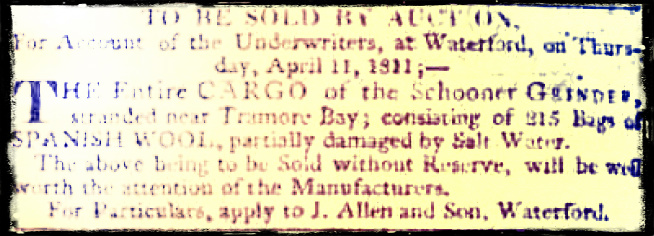
23. The Grinder, February 1811. The Grinder, Master William Robinson was stranded in the bay on 17 February while on a journey from Lisbon for Plymouth.38She was a single decked schooner, 86 tons burden, with a draught of water of 9 ft., American built in 1786 and owned by Forrester. She was a regular trader between London and Viana do Castelo in Portugal. Her entire cargo consisting of 250 bags of Spanish wool, partially damaged by salt water, was auctioned at Waterford, on Thursday, April 11.39
24. The Pleasant, 25 September 1811. The Pleasant, Master Gibson, of Whitehaven, from Ayr to Cork, was driven on shore on Wednesday night. Crew saved.40 On Wednesday evening last, about half past 8 o’clock, the brig Pleasant, John Gibson, master, was wrecked at the Islands of Keane, but we are happy to be enabled to add, the crew, consisting of six persons, were all saved. She was from Air, in Scotland, bound to Cork, with a cargo of coals.
25. The Albion, 1 December 1811. The Albion, Master Robert Thomas was 128 ton, single decked brig, with a draught of water of 10 ft., built in Arundal, only 2 years old, armed with 2 x 4 pounders, with an A1 classification, bound from London to Waterford.41 On Sunday evening, about seven o’clock, in a heavy gale at SW, the brig Albion, Robert Thomas, master, from London, bound to this port, with a valuable cargo, was driven into Tramore Bay, where she was stranded about 200 yards below the men’s bathing place. We have the satisfaction to say, the crew were all saved, and the cargo has since been landed, having sustained very little damage. It is placed under the custody of the revenue officers and yeomen. Hopes are entertained that the vessel will be got off. We feel particular pleasure in being able to add that the characteristic humanity and honesty of the inhabitants of Tramore were conspicuous on this occasion, as there appeared not the least disposition to plunder or even embezzlement. – Waterford Mirror.42 The Albion was got off on 31 December.43 The owner of the Albion wrote a letter of gratitude to the people of Tramore, which was published in the local newspapers: Richard Pope: With the warmest gratitude, returns his sincere acknowledgements to Mr James Walsh of Tramore, Captain James Blake of Waterford and the inhabitants of Tramore in general, to whose friendly and active exertions, he is in a great measure indebted for the safety of the brig Albion, lately stranded in that bay; nor can he omit mentioning a circumstance highly creditable to them, and perhaps, unparalleled on any coast-that, after having lain in so perilous a situation for above four weeks, she should ultimately have got off without even the most trifling loss to her tackle and furniture. Waterford 4 January 1812.44
26. The Benjamin, 8 December 1811. The Benjamin, H Baker, master, was a single decked schooner of 81 tons burden, with a draught of water of 10 ft., built in America and owned by its captain.45 She held an E2 classification, a 2nd class ship, built of 2nd class materials. On Sunday last, between the hours of two and three in the afternoon, a vessel narrowly escaped shipwreck off Tramore. The Benjamin, Baker, master, from the coast of Africa, for Liverpool, with redwood, palm oil, ivory, &c. &c. ran into the bay, mistaking it for the harbour of Waterford. The weather was hazy, and the mast of the Albion, which was occasionally seen, induced Captain Baker to believe, that she was riding at anchor. After some time, however, he discovered the error into which he had fallen, and took every precaution to secure the safety of the ship. A small part of the cargo was thrown overboard, and the captain himself, at considerable hazard, went ashore in his boat, in order to ascertain his situation and to procure assistance. Mr Walsh, of the hotel, whose humanity and zeal, on these occasions, entitle him to public gratitude, made signal for Captain Baker’s boat, and afterwards, carefully and eagerly supported by the inhabitants, afforded him every aid and information which his situation required, or the circumstances would allow. Captain Baker also derived considerable advantage from the accidental presence of Mr Allan, junior and Mr Kennedy, agent on this coast, for various insurance companies. Two boats and crews, belonging to Tramore, were procured and by extraordinary efforts, the vessel was next day conducted out of the bay, and arrived safely in the harbour, with only the loss of her cables and anchor, Waterford Chronicle.46
27. The Shamrock, November 1814. The name of the vessel, mentioned in our last as having been lost off Bonmahon, was The Shamrock, belonging to Kinsale.47
28. The William, 4 January 1815. The schooner Williams, Hall, of and from St. John’s, Newfoundland, to Ross, laden with fish and oil, ran on shore in Tramore Bay on Wednesday morning. Crew saved, and Vessel unloading.48 Port News, Passage Jan 7. William, Hall, St. John’s, Newfoundland, last from Tramore, for Ross, fish and oil. The whole of the cargo landed at Tramore, the vessel arrived here in ballast.49
The schooner, William, Hall, mentioned in our last to be on shore at Tramore, was got off on Saturday morning, after being lightened of her cargo, and shortly after arrived at our quay. We have had frequent opportunities of recording the skill, courage and humanity displayed invariably by all ranks of the inhabitants of Tramore in saving the crews and cargoes of vessels driven into their bay. But we do not remember to have ever, even there, known of a vessel being completely discharged in one day, and on the following morning being safely moored at the distance which the Quay of Waterford is from the bay of Tramore; and, let us add, without five shillings of damage to tackle or cargo. Captain Hall has returned his public and well deserved thanks, and those of his owner, to John Walsh, of Tramore esq, Michael Kennedy of Ballydavid, esq and Capt. Patrick Hurley, of Tramore. (See below) To the Editor of the Waterford Mirror. Sir, I am directed by my owner, Mr Patrick Brien, to return public thanks, through your paper, to John Walsh esq, Surveyor of the Coast, Michael Kennedy esq, and Captain Patrick Hurley, for their united and most extraordinary exertions in getting off the schooner William, of and from St. John’s Newfoundland, of which vessel I am Master, stranded on the beach of Tramore, on the night of the 3rd instant, through the conduct of an ignorant or improper pilot, of Passage, who boarded said vessel on the evening of the said day, and took charge and further bringing said vessel round safe to the Quay of Waterford, after discharging and storing the entire cargo, consisting of fish and oil, at Tramore, without damage or loss in discharging. I am sir, your most obedient servant, William Hall, Master. Waterford January 7, 1815.50
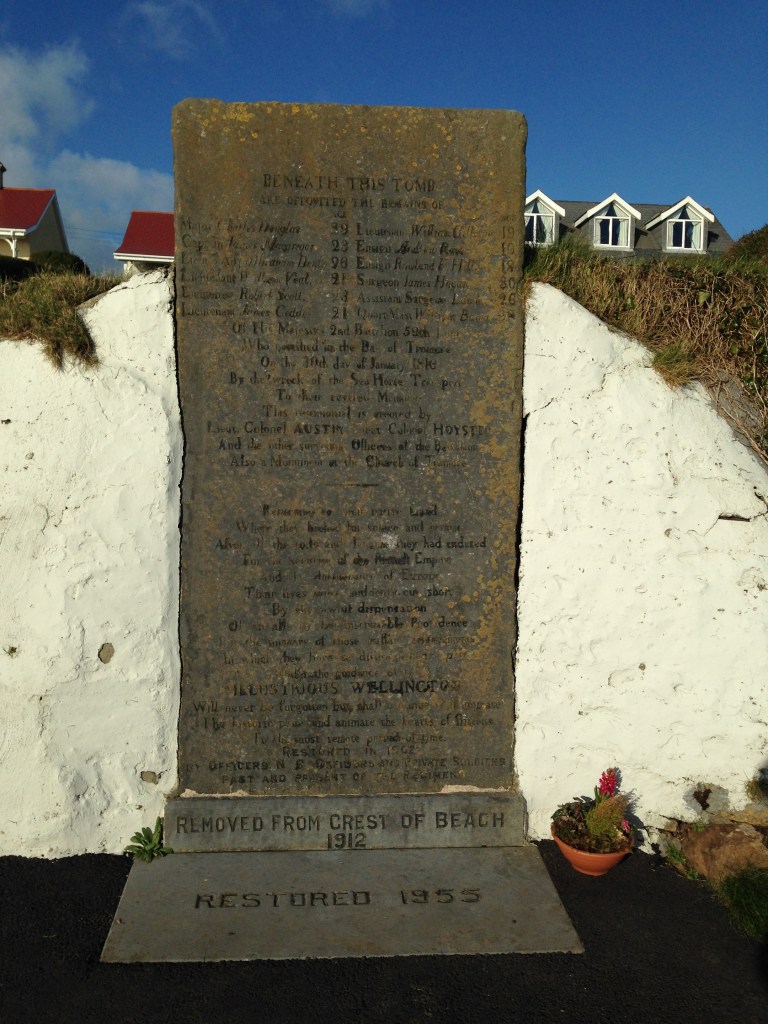
29. The Sea Horse, 30 January 1816. The following is Captain Gibbs’ somewhat inaccurate account of the shipwreck:
The Seahorse took on board at Ramsgate, on the 24th Jan. 16 Officers, 287 men, 33 women, and 38 children- crew 17 in number; she sailed on the 25th, and the evening falling calm, she anchored in the Downs. About 11 o’clock in the morning of the 26th weighed anchor, with the wind at N. N. W. light breeze- about midnight off Dungeness. On the 27th in the morning Beachy-Head bearing about north-about seven in the evening off Dunnose, Isle of Wight- about midnight Portland lights N. E. On Sunday the 28th off the Start in the morning at daylight, with a fine breeze at N. N. E.- about 5 in the afternoon passed the Lizard lights- at 11 passed the Longships 1 ½ mile distant- at 12 it bore N.N.E., 8 miles distant. The 29th in the morning a fine strong breeze at S.S.E.; at noon freshening very much- about 4 p. m. saw the land about 12 miles distant; observed that it was Ballycotton Island. The Mate, John Sullivan, going up the forerigging to look at the land fell down on the forecastle, broke both his legs and arms, and never spoke more-died almost three hours afterwards. Hauled our wind for Kinsale light, blowing a strong gale, and coming on very hazy and dark, intending when we saw the light, to run down along the land for the entrance of Cork.; but having run two hours, and not seeing the light, the Captain began to get doubtful to proceed any further, the weather being so thick and hazy, and a most tremendous sea running, so we close reefed our topsails, and hauled close to the wind, lying W.S.W. About 8 o’clock she fell off- wore around on the other tack- most of the night lying, about S.E.- wind about S.S.W.; but owing to the flood tide setting strong on the shore, and a heavy sea running, she drifted very fast inshore. About 5 in the morning saw the land on our lee beam, which was Minehead, and which forms the southern part of Dungarvan Bay- drifting very fast to leeward. At six let a reef out of the topsails and set the mainsail- blowing very hard. About half past 10 a. m., the foretopmast went over the side, and a seaman who was in the foretop had his back and thigh broken. About 11, just after the wreck was cleared, the mainsail split all to ribbons- drifting to leeward very fast-saw the Hook light-house under our lee bow, but the sea sending us so fast to leeward we could not weather Browns-town-head. Clewed up the sails, and brought up under the head in seven fathoms, with both anchors, and near 300 fathoms of cable a-head- the sea making breaches right over us from stern to stern. About 12 the anchors dragged, the wind and sea still increasing.- At ten minutes past 12 she struck; we then cut away the mizzen and main masts; the rudder went off the second strike, the sea breaking most tremendously over us; in one hour the ship parted by the main hatchway; all the boats had been washed away before. It was a most awful scene- 394 souls on board, all clinging to different parts of the wreck! One Officer’s wife and two children in her arms met their fate in the great cabin; a Serjeant’s wife, with her three children clasped to her breast, resigned herself to her fate between decks; women were heard encouraging their husbands to die with them! There was not the least disturbance among them, most of them ejaculating prayers! After she parted we were all washed off, but about 30 that were left clinging to the forerigging. About 60 in all reached the shore, but for the want of assistance only 4 officers, 25 soldiers, (two of whom are since dead) Capt. Gibbs, and two seamen were saved. Mr Hunt, of Tramore, and his man, Mr. Duckett, jun. and two countrymen, one named Kirwan, were the persons who contributed most to save the lives of the unfortunate people. To the indefatigable exertions of Mr. Hunt, in getting us up to the cottage at the Rabbit-burrow, and sending for spirits to his own house, and lighting large fires for our accommodation, we are principally indebted for our lives.51
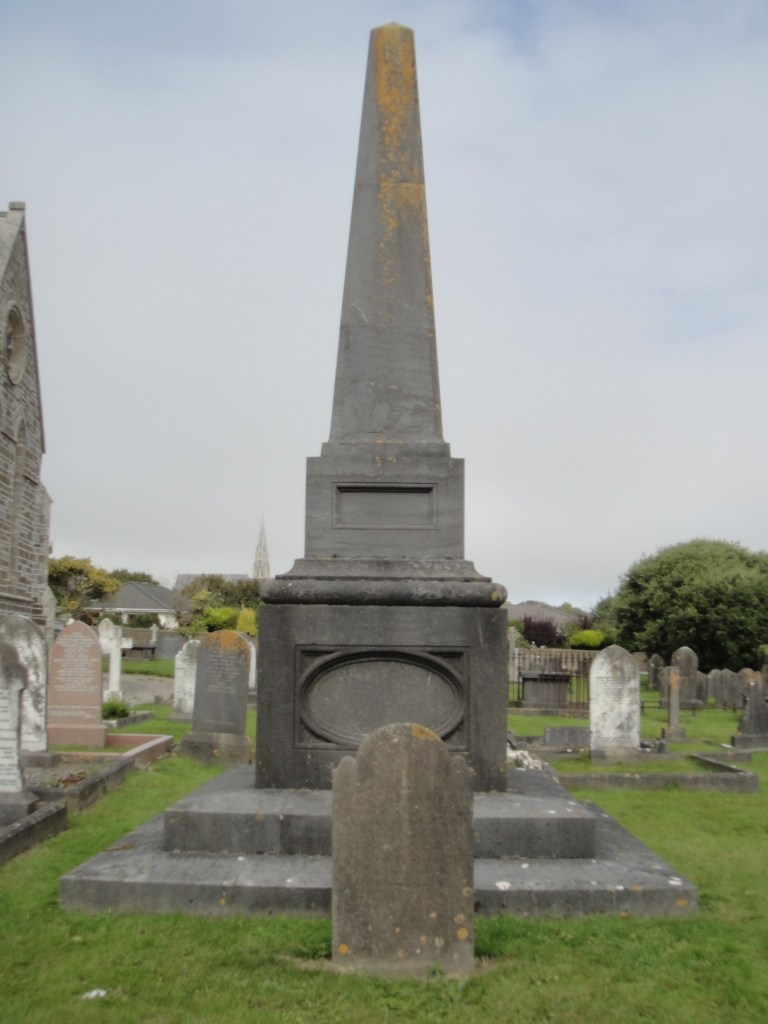
The number of people on board the Sea Horse at the time of the wreck, given in most accounts are incorrect, being initial based on inaccurate figures supplied by Captain Gibbs. According to Gibbs, the Sea Horse took on board at Ramsgate, on the 24 January, 16 Officers, 287 men, 33 women, and 38 children and a crew 17 in number. There was also a passenger, Lieutenant Allen of the Royal Navy, which including Gibbs himself, comes to a total of 393 souls. Total losses were reported to be 12 officers, 15 seamen, 71 women and children as well as the 264 enlisted men, a total of 363. While the numbers reported to be saved were 4 officers, 23 enlisted men, one of which died shortly afterwards and 3 seamen.
However a letter from Ramsgate dated 6 February clearly related that, ‘the statement of men on board the Seahorse is not correct-there embarked here 14 officers, 266 men, 33 woman and 34 children.’52 While there can be little doubt that there were 16 officers on board, the number of enlisted men, women and children remains open to question.
Furthermore, an investigation into the Regimental Pay List from 25 January 1816 to 24 March 1816 confirm the deaths of 4 senior enlisted staff, 4 colour sergeants, 1 drum major, 10 sergeants, 14 corporals, 15 drummers and fifers and 197 privates on 30 January 1816, a total of 245 dead men, 2 of which died at the wreck of the Lord Melville. Adding the 22 enlisted men that are listed in the pay list as having survived the wreck of the Sea Horse, the total of the enlisted men recorded to be on board comes to 265.53 A figure much closer to the Ramsgate tally; if we take this reckoning as the more accurate of the two, then the numbers on board amount to 16 officers, 265 enlisted men, 33 woman and 34 children, 18 seamen and one passenger, a sum total of 367 souls of which 338 were lost. However, if the number of soldiers on board is incorrect in the official tally, then the number of women and children is also probably incorrect. Gibbs stated that there were only 17 seamen on board, including himself. The exact figures of those on board and those lost is unknown.
30. The Apollonia, 31 January 1816. On the night of Wednesday, 31 January, the brig, Apollonia, of Caernarvon, John Parry, Master, bound from London to Cork with a general cargo, teas etc. was stranded near the bathing place and in a short time, went to pieces. The Apollonia was a brig of 123 tons burden, single decked with beams and a draft of eleven feet of water when loaded. She was built in Caernarvon in 1803 and was partially owned by her captain. She was last surveyed in 1810 when she was described as a regular trader between London and Cork and graded as E1. Tramore, Feb. 1, 1816. The brig which was wrecked here last night was the Apollonia, of Caernarvon, John Parry, Master, from London for Cork, with a general cargo of teas,liops, &c. &c. The vessel has gone to pieces, and the crew (seven in number), were fortunately saved by the extraordinary exertions at the risk of their lives, of the Gentlemen at foot mentioned. I am sir, yours truly, K Cornelius Henry Bolton, Samuel Davis, Edward Courtenay, William M Ardagh, Richard Sargent, Matthew Turner, Esqrs., Rev Mr Frazer, &c, &c, &c. Collector Wallace was on the spot and gave every assistance; he acted with the greatest humanity towards the unfortunate captain and crew.54
31. The New Saint Patrick, 29 September 1816. The New St. Patrick, Finn, from Cork to Dublin, was driven into Tramore Bay, 29th Ult. Crew and 10 passengers saved.55 Yesterday a sloop from Cork for Dublin with flour, paper &c. went ashore at Tramore. She had several passengers, all of whom, with the crew, were saved, and expectations are entertained of getting off the vessel, when discharged of her Cargo.56
32. The Agnes, December 1816. The Agnes, McEwen master, was a single decked brig, 105 tons burden, with a draught of water of 11 ft. when loaded. She was built in the port of Glasgow in 1815. She held an A1 classification and was last described as a constant trader between Greenock and Hamburg.57
The Agnes, McEwen, from Greenock to Gibraltar, Malta &c. which was on shore in Tramore Bay, has been got off and carried into Rhineshark Harbour, damaged and with the loss of rudder and cargo landing.58 On Saturday last, about four o’clock, the brig Agnes, John McEwan, master, bound from Greenock for to Gibraltar, Malta &c. with a cargo of sugar, &c. ran, in the severity of the storm into Tramore Bay, but, fortunately, got into the small harbour of Rineshark, from which the captain and crew, nine persons in all, safely landed in the boat of the vessel, and experienced a hospitable reception from the peasantry. Till last night, storms of wind have blown ever since, but their direction was not unfavourable to the safty of the Agnes.59
We have to state an extraordinary circumstance with respect to the brig Agnes, which got into Rineshark Harbour on Saturday last. Two of the pilot Committee of this city, with six experienced pilots, went to Rineshark, and tendered their services, free of expense. This offer the Captain declined, and afterwards hired boats for his assistance. We have heard more on this subject than it would be wise to divulge. The matter is in the hands of the proper authorities.60
The Brig Agnes. We have the authority to state that the entire cargo of the brig Agnes, stranded in Rineshark, on the night of Saturday week, has been got landed and safely deposited in the King’s Store; and we notice with peculiar satisfaction what must reflect the highest credit on all the parties concerned in the saving of the vessel and the discharging of the cargo (valued at £40,000) that not a package or any article of any description whatsoever is missing or has suffered the least diminution or damage, except some refined sugars, which had been partially injured by salt water, previous to their being landed. With respect to the mysterious paragraph published in the Waterford Chronicle on Thursday, we are directed to say that due notice shall be taken note of forthwith …that the Author or Authors of the calumnious reports which have been in circulation are bound to come forward openly to avow them and that these reports shall pass unregarded by those against whom insinuations, so wanton, illiberal and unnecessary have been levelled.
Waterford 3rd January 1817. To the Editor of the Waterford Chronicle :
Sir, Having read a paragraph in your paper of the 2nd instant, respecting the Brig Agnes, of which vessel I am Captain and Owner, I feel it incumbent on me to repel the unwarrantable insinuation it conveyed against my character and conduct, by a brief statement of facts, which I can establish upon unanswerable grounds. On the evening of the 28th ult., in a violent gale, I was unfortunately driven into Tramore Bay and soon after the vessel got aground on the Bar of Rineshark, in the midst of tremendous breakers and her rudder was beaten off. As our destruction seemed inevitable and was momentarily expected, in order to save our lives, the boats were launched and after much peril and struggling with the waves, all hands reached the shore in safety. I immediately inquired for some respectable person in the neighbourhood, in whom I might confide for protection and assistance; and having been informed that Mr Nicholas Hearn had had some short time before, the charge of a vessel similarly circumstanced and that his conduct was highly approved of, I sent a messenger for him, and on his arrival, explained my wishes, when he undertook the care and management of the vessel and the valuable property entrusted to my charge and pledged himself for the integrity and activity of those he should employ. Shortly after, two Gentlemen came from Waterford, who informed us that they belonged to the Pilot Committee, together with six persons, whom they represented as “experienced pilots,” who offered there services; but, on questioning these pilots, as to their knowledge of Rineshark Harbour, one of them only pretended to be acquainted with it, and when, after some consideration, we had all repaired to the beach and I offered to board the vessel in my own boat with any of those experienced pilots, they unanimously refused to accompany me. This will, I trust, satisfactory explain whether they refused or I declined their assistance; and I have the high gratification of stating that owing to the judicious and indefatigable exertions of Mister Hearn and by those employed by him, who were all experienced in Rineshark Harbour, aided by the unremitting attention and under the directions of James Wallace Esq. The Collector of the Port, a property worth £40,000 has been landed and effectually preserved to the proprietors, without the slightest pillage, and without sustaining any serious damage. The paragraph states that I hired boats to give assistance. This assertion is unfounded, for my own boats, under the guidance of the Rineshark fishermen, were alone employed in landing the property. The paragraph further adds “We have heard more on this subject than it would be wise to divulge. The matter is in the hands of the proper authorities”. Of the tendency and affected mystery of this passage, I will merely observe, that there may be some wisdom in not circulating groundless and whispered calumnies. The Public, however will determine whether an attempt in a newspaper to blast the character and reputation of a stranger in the country, without first applying to him for his account of the transaction, or affording him any opportunity of vindication, or explanation, is not a violation of every principle of candour and impartiality. I gladly embrace this opportunity of returning my public and grateful acknowledgements to Mr Hearn’s family at Ballymacaw, for their most kind and hospitable reception of myself and my crew. I have, also, real pleasure in bearing testimony to the good conduct of the peasantry in the neighbourhood of Rineshark. R. McEuen Waterford, January 3, 1817.
The depositions alluded to in the letter from Captain McEuen, are in our possession and we shall obey such instructions as we may receive concerning them; but we must observe, that we shall exclude all abase, and that, as we have dealt with the captain of the Agnes, every publication on the subject must hereafter be paid for as advertisements.61
James Dombrain, commander of the Preventive Water Guard, accused Mr Hearn of being a smuggler, in the House of Lords in 1820,
33. The Shamrock, Walsh, from Waterford to Gibraltar, (with the cargo of the Agnes, from Greenock, stranded in Tramore bay in December), grounded on Waterford bar the 2nd inst., knocked off her sheathing and put back to repair.61 This incident is often listed as a Tramore wreck, but obviously wasn’t one.
34. The Oscar, 16 February 1817. The Oscar, Meyers, from Baltimore for this port, was driven on shore in Tramore Bay 17th inst. and it was feared would be wrecked. Cargo expected to be saved.62

On the night of Sunday last, The Oscar, an American ship, Captain Meyers, laden with flour, for Liverpool from Baltimore, struck on the bar near Rhineshark, in the bay of Tramore. Her cargo is likely to be saved as the weather has not been violent and we trust that the vessel will be got off with safety.63
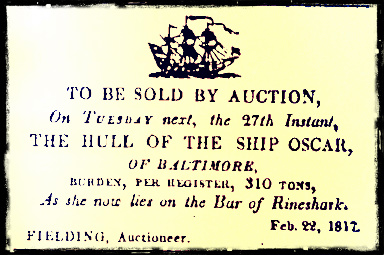
35. The Beauty, 5 October 1817. The Beauty, Northwood, of London, from Poole to Liverpool with pipe-clay, struck at the bar of Rhineashark, near Waterford, about 5th inst. and split some of her sails.64
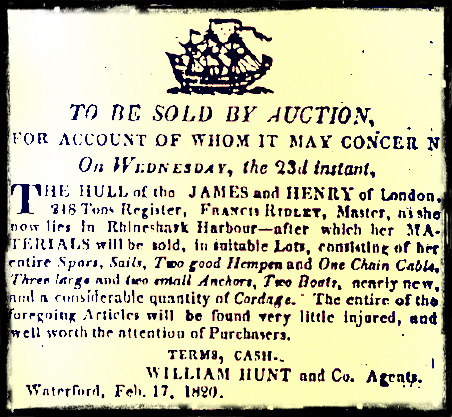
36. The James and Henry, 17 December 1819. The James and Henry, F Ridley, master, was a brig of 221 tons burden, single decked with beams, sheathed with copper over boards, with a draught of water of 14ft., built in Sunderland in 1807 and owned by its captain & Co. She held an E2 classification, a 2nd class ship, built of 2nd class materials.65 The James and Henry, of London, Ridley, from Maranham to Liverpool, was on shore at Tramore Bay, on 17inst. Crew and most of the cargo saved.66 The James and Henry, Ridley, from the Brazils to Liverpool, was on shore at Tramore Bay, on the 17inst.67
37. The Medina, 17 December 1819. Bristol, Dec. 21—The Medina, Andrews, from Cadiz, was driven on shore the I7th instant, in Tramore Bay ; and if the weather became moderate, both vessel and cargo were expected to be saved.68
38. The Harriot and Pheasant, December 1820. Falmouth, 7th January, The Pheasant, Banks, is not lost as reported: She has put into Tramore Bay, near Waterford, where she was bound with The Harriot, Banks, which vessel she sailed in company with from Swansea. The latter it is feared has floundered as a boat and some materials marked with her name have been picked up upon the coast.69 The Harriot, Banks, from Swansea to Youghal, was lately lost in Tramore Bay and all on board drowned.70
This concludes the recorded shipwrecks for the first twenty years of the nineteenth century, which sets the scene for the next post, which will be about the circumstances surrounding the construction of the Beacon Towers on the headlands of Tramore Bay and the famous Metal Man.
- Hibernian Chronicle, 3 February 1800. ↩︎
- Hull Packet, 17 November 1801; Stamford Mercury, 20 November 1801. ↩︎
- Lloyd’s List, 2 February 1802. ↩︎
- Saunder’s Newsletter, 23 January 1802. ↩︎
- Lloyds Register, 1802. ↩︎
- Lloyd’s List, 7 January 1803. ↩︎
- Belfast Newsletter, 7 January 1803. ↩︎
- Freeman’s Journal, 14 January, 1804; Waterford Mirror 11 January 1804. ↩︎
- Lloyds Register,1804. ↩︎
- Caledonian Mercury, 9 February 1804. ↩︎
- Cambrian, 12 May 1804. ↩︎
- Freeman’s Journal, 3 November 1804 ↩︎
- Waterford Mirror, 13 March 1805. ↩︎
- Waterford Mirror, 16 March 1805. ↩︎
- Lloyds Register, 1806. ↩︎
- Lancaster Gazette, 15 November 1806. ↩︎
- Lloyds Register, 1806 ↩︎
- Finn’s Leinster Journal, 15 February 1806. ↩︎
- Dublin Evening Post, 11 November 1806. ↩︎
- Waterford Mirror, 21 January 1809. ↩︎
- Lloyd’s List, 27 January 1809. ↩︎
- Lloyds Register, 1809. ↩︎
- Waterford Mirror, 30 January 1809. ↩︎
- Waterford Mirror, 11 November 1809. ↩︎
- Waterford Mirror, 11 December 1809. ↩︎
- Caledonian Mercury, 18 December 1809. ↩︎
- Waterford Mirror, 11 December 1809. ↩︎
- Waterford Mirror, 24 September 1810. ↩︎
- Lloyds Register, 1812. ↩︎
- Lloyd’s List, 23 November 1810. ↩︎
- Waterford Mirror, 17 November 1810. ↩︎
- Waterford Mirror, 19 November 1810 ↩︎
- Lloyd’s List, 12 February 1811. ↩︎
- Waterford Chronicle, 9 February 1811. ↩︎
- Freeman’s Journal, 14 February 1811. ↩︎
- Waterford Chronicle, 3 March 1811. ↩︎
- Freeman’s Journal, 23 February 1811. ↩︎
- Lloyd’s List, 26 February 1811. ↩︎
- Waterford Chronicle, 11 April 1811. ↩︎
- Lloyd’s List, 1 October 1811. ↩︎
- Lloyds Register, 1811; Lloyd’s List, 7 January 1812. ↩︎
- Freeman’s Journal, 7 December 1811. ↩︎
- Waterford Mirror, 1 January 1812. ↩︎
- Waterford Chronicle, 7 January 1812. ↩︎
- Lloyds Register, 1811. ↩︎
- Freeman’s Journal, 17 December 1811. ↩︎
- Belfast Newsletter, 2 December, 1814. ↩︎
- Waterford Mirror, 7 January 1815. ↩︎
- Waterford Mirror, 9 January 1815. ↩︎
- Same. ↩︎
- Waterford Mirror, 5 February 1816. ↩︎
- The Times, 8 February 1816. ↩︎
- 59th Foot 2nd BN 1815 & 1816 War Office Regimental Pay Lists, 25 January 1816 to 24 March 1816 , WO/12/6870, The National Archives, accessed online at http://www.nationalarchives.gov.uk/. ↩︎
- Waterford Mirror, 3 February 1816. ↩︎
- Lloyd’s List, 4 October 1816. ↩︎
- Waterford Mirror, 30 September 1816. ↩︎
- Lloyd’s Register, 1817. ↩︎
- Lloyd’s List, 7 January 1817. ↩︎
- Waterford Chronicle, 31 December 1816. ↩︎
- Waterford Chronicle, 2 January 1817. ↩︎
- Waterford Chronicle, 9 January 1817. ↩︎
- Lloyd’s List, 8 April 1817. ↩︎
- Lloyd’s List, 21 February 1817. ↩︎
- Waterford Chronicle, 18 February 1817. ↩︎
- Lloyd’s List, 14 October 1817. ↩︎
- Lloyds Register, 1819. ↩︎
- Lloyd’s List, 21 December 1819. ↩︎
- Public Ledger and Daily Advertiser, 22 December 1819. ↩︎
- Lloyd’s List, 21 December 1819. ↩︎
- Lloyd’s List, 12 January 1821. ↩︎
- Lloyd’s List, 16 January 1821. ↩︎

 Tramore of Yore
Leave a comment