
For centuries, Tramore Bay in County Waterford has held an infamous reputation as a graveyard of ships. The most famous of the wrecks being that of the Sea Horse transport, which driven into the bay and shipwrecked in a storm, over two hundred years ago, on 30 January 1816. This article chronicles the reports of shipwrecks, narrow escapes and other nautical occurrences of note in the bay area. Many of the references, while taken from contemporary published sources, were themselves at least second hand and probably even third or fourth hand reports of the actual events. So while it is true to say that these events were reported on, it is a different thing entirely to say that they actually happened in the manner that they were reported. Many of the locations given are vague, some saying ‘near Tramore’ or ‘at Tramore’. It has become obvious that many of these instances actually occurred off Islandikane, Annstown and as far west as Bonmahon and to the east, off Ballymacaw and beyond. So for the purpose of completeness, the geographical area covered extends to these areas.
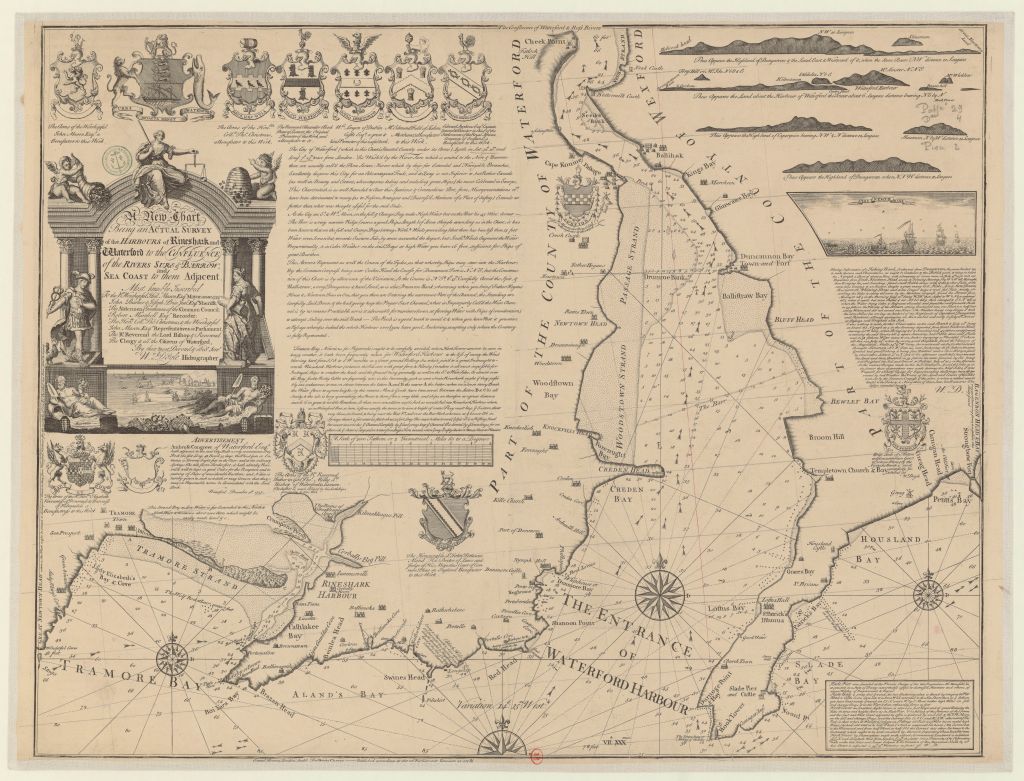
William Doyle’s Chart

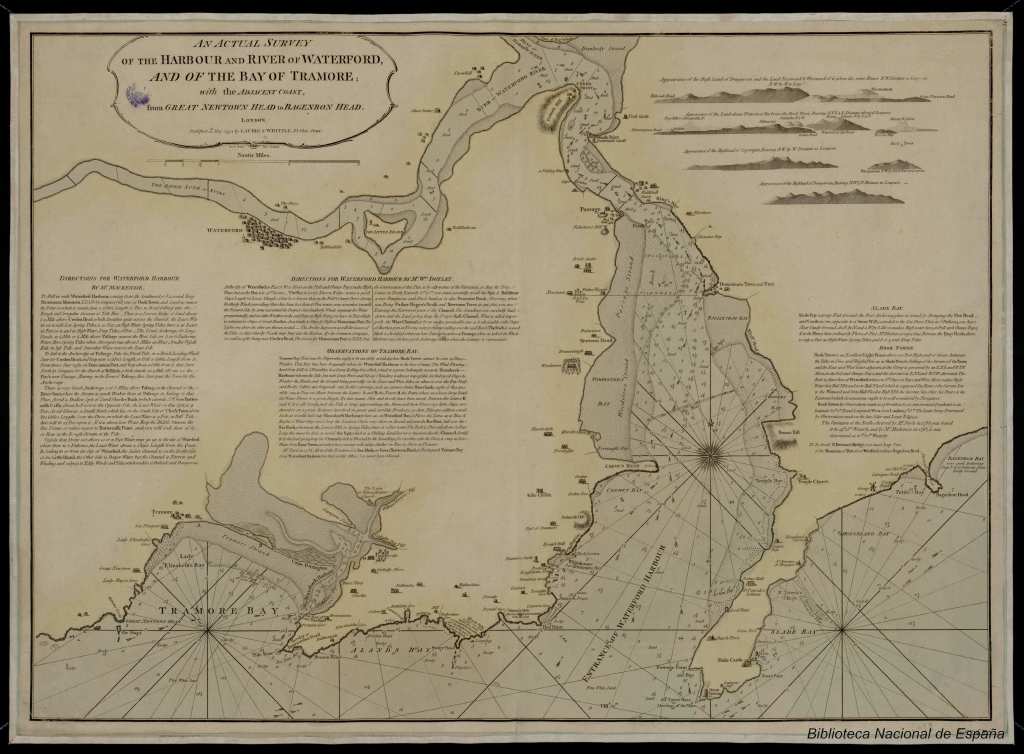
In 1738, William Doyle, the hydrographer surveyed the coast of the county and published a chart of Waterford Harbour and Tramore Bay in 1738.1

Doyle noted that the bay was notorious for shipwrecks and ought to be carefully avoided. According to Doyle, the real danger came in heavy weather when Hook Tower could be mistaken for Waterford Harbour. When the wind blows hard from SSE to SW tumbles in a great ground rolling sea which together with to a great in-draught towards Rhineshark Harbour, where the tide sets with great force and velocity, renders it almost impossible for embayed ships to weather the heads and the ground being generally as well on the east and west side, as almost over the bay foul and rocky cables are frequently cut, in this extremity such as can’t obtain Rhineshark ought if they possibly can endeavour, to run on shore between in the middle of the strand, the nearer to the western end the better, where on a loose stony beach the water flows to a great height; by this means men and goods have been saved. The bay at the eastern third of the strand is all sandy and the tide is long approaching the shore and there flows very little, and ships are therefore at a great distance involved in great and terrible breakers. So that men are seldom saved.
What follows is a list of the wrecks and near misses at Tramore, each entry accompanied by a direct quotation from at least one contemporary source.
- The first ship to be recorded as wrecked in the vicinity of Tramore Bay was a navy fire ship that was driven against Brownstown Head in a raging storm on 17 November 1703:News from Waterford, Mr Kent, Collector at Waterford in his letters to the commissioners on the 20th, says that, last Wednesday came in a ship about 50 tons, to anchor in Tramore Bay, but that night she was driven against Brownstown Head by a very violent storm and dashed to pieces. No lives were saved and the surveyor of Passage who was sent to look for wreckage, reports that nothing worth saving was found [details]. The bodies of dead men beaten to pieces against the rocks were found. Enclosed papers include a fragment of a commission to Lord Granville, Lieutenant-General of Ordnance, [details], gives rise to the belief that the vessel was a fire ship or bomb vessel belonging to the Queen.2
2. Triple Wreck. The writer has not located any other wrecks in the area until three ships were wrecked on the same day in January 1732. From the London newspapers: We hear from Tramore near Waterford in Ireland, that on Saturday morning last three ships were lost in that bay, viz. one from Harve, laden with apples, on board of which was Sir Richard Levings, who, with the crew, were saved; one from Bordeaux, laden with wine, whole crew, except two boys, were lost; and one from the west of England, laden with bark and staves, the crew saved.3 The lack of recording of wrecks in the bay during this time is probably due to the scarcity of newspapers and other official records in the period, rather than a lack of wrecks in the bay. The 1732 wrecks were probably reported because Sir Richard Levings was a baronet and one of the judges of the King’s Bench in Ireland.
3. The John and Marsha: 8 January 1745: On the 8th instant about 11 at night, the John and Marsha, from London bound to Dublin, laden with 470 quarters of malt, was wrecked in Tramore Bay, within five miles from Waterford. The master and men were saved but the ship went all to pieces in three hours’ time and the cargo was lost.4
4. Unknown Vessel, 24 January 1756: Last Tuesday night, one anchor of brandy, a nest of drawers, and a cabin and stern of a vessel, was thrown on the strand of Tramore, supposed to belong to some vessel cast away on this coast.5
5. Port Glasgow: Waterford, 23 October 1756: In the storm which happened here on Wednesday night, the 6th instant, a ship, the name and master unknown, with passengers and convicts on board, was drove on shore at Ballymakaw, near Tramore Bay, and the crew, master, &c. on board her, to the number of twenty, perished in the sea, except the Super-Cargo, who had the good luck to save himself by getting ashore on a plank, but now lies dangerously ill; said vessel came from Glasgow, and was bound to Cork to complete her lading, and from whence to proceed to America; her said lading chiefly consists of wearing apparel, linens, and other dry goods. Proper persons are sent down to hinder her being plundered by the country people, and care taken to save and preserve as much cargo, hull, & c. of said ship, as is possible.6 Further details from Waterford, on 23 October: Last Wednesday night, a vessel from Glasgow, bound to Cork, called the Port Glasgow, Alexander Haddington, master, was drove by the storm on a rock near Donmore, within a few miles of Tramore, near Waterford, where she was dashed to pieces: the master and twenty of the men on board, were found drowned on the strand next morning; two others had some life and were taken care of by a humane gentleman, notwithstanding which, one of them died the same day, the only man alive out of 23, is the super-cargo of the vessel. They were part of the goods saved, consisting of some linen blue and white checks, Scotch handkerchiefs, threads, stockings, & c. but the whole was very inconsiderable.7
6. Unknown: Dublin, 5 March 1759: Saturday se’enight, a very melancholy accident happened near the western point of Tramore Bay in the county of Waterford; a ship being forced into the bay by the late tempestuous weather, struck and went to pieces directly. Every person on board perished. It is not known where she was bound but suppose she came from London by some porter which was cast on shore by the tide and a parcel of staves, hoop & c.8
7. Providential Friends: 1763. We hear from Waterford, that the Providential Friends of Liverpool, Harrison, commander, bound from this port for thence, was wrecked in Tramore Bay, and but three of the crew were saved.’9 The Providential Friend, Harrison, from Liverpool for Waterford, put into Drunmoor Bay the 28th instant in distress; the crew quitted her and took to their boat which overset, and out of 11 men, 8 of them perished.10
8. The Earl of Sandwich: 30 November 1765. This ship was built in Yarmouth in 1762. She was 120 tons, single decked and owned by a Mister Polgrove: The Earl of Sandwich, Cockran, from the Canaries for London, being drove by contrary winds up the Irish Channel, the crew rose on the 30th Ult. and murdered the captain, mate, a boy, a gentleman, his lady and daughter, passengers; after which plundered the ship and opened the ballast port with intent to sink her: since which we hear the ship was stranded in the river of Waterford.11 A Captain Honeywell from Newfoundland, reported on 4th December that about four leagues to the SW of the Tower, he had run foul of a large three mast vessel. The weather was very hazy, which prevented his seeing her. Her top gallant yards were up, and she was so deep in the water, that he could only see her rails. She had no boat on board nor could a living creature be seen. Upon this report, eight boats went out from Waterford, but the sea was so high, they could not venture so far to the westward, and returned without being able to give any account of her. However, some 50 or more pipes of wine were drove on shore at the Islands of Cain, on the estate of Mr Wyse. Mr Gahan, the Land Waiter, and a party of soldiers went to secure what was driven on shore. Later, a London cocket found on the strand of Garreras which was for a hogshead of sugar in loaves, going to the canaries, dated 10th of August 1765, and shipped on board the earl of Sandwich, signed William Bates; it was wrote on thin leather, and by that means preserved. A part of the stolen goods were later recovered and the perpetrators were hanged and their bodies displayed on the Muglins Rock, off Dalkey Island. The ship was auctioned at the Customs House, Waterford, on 27 August 1766:
To be sold by public cant, on the Customs-house quay at Waterford, on Monday the 15th day of September next, one hundred and sixty three pipes, hogsheads and quarter casks of choice wines, of the growth of the Canary Islands, some raw silk and broad cloth, saved out of the wreck, Earl of Sandwich, stranded at Tramore, in the harbour of Waterford. The Cant to begin at eleven o’clock in the morning and to continue until all are sold.12 John Rogers of Tramore was said to have made a salvage claim on 23 February 1767 for the remaining 1,200 dollars that were found aboard.
9. St Jean: 1768, Dublin, 31 December: Saturday the 17th instant, the hull of a large vessel, with her masts, sails and rigging standing was drove ashore at Bonmahon, three miles westward of Tramore, on part of the estate of Lord Viscount Mount Florence; there was no living creature on board. She proves to be the St, Jean, supposed to belong to France; and, it is conjectured, the whole crew must have perished as two of the bodies have since been driven ashore.13
10. Two Friends: 10 March 1769: We hear from Waterford that a vessel was lost in Tramore Bay on Friday night last, her name and destination not yet known’.14 Kilkenny 15 March, we learn from Waterford, that on Friday last, the Two Friends, Captain Heney,on a journey from London to for that port, was drove upon a rock about two miles to the westward of Tramore, as she was making the harbour of Waterford, and unfortunately hove to pieces. The captain and eight of the crew perished, and two men only were saved; the cargo, which consisted chiefly of tobacco, sugar, iron and hops, is entirely lost.15
11. Unknown brig: June 1769, A brig with a lyon-head, burthen about 200 tons, bound from Dublin to some port in Munster is wrecked in Tramore Bay and the cargo entirely lost but the crew were saved.16
12. Friendship: August 1769, Thursday morning, the Friendship, from Cork for Waterford, loaded with staves, was drove on the Tramore strand, but it is thought that she will be got off, without receiving any damage.17
13. The William: 1769, Waterford, 5 December, Last night was stranded the ship William, Captain Hurrow, Newfoundland, with fish, oil and passengers.18 The “William” of Cork, Captain Harrow, from Newfoundland, with fish, oil, and passengers, was put on shore at Tramore Bay, Dec. 4th, and as it then blew very hard, it’s thought she will go to pieces.
14. Unknown Schooner: Waterford, 7 August 1772: We hear from Tramore, that a schooner, bound from Cork to Liverpool, in ballast, was during the fog on Wednesday night last, put ashore there, but it is thought she will be got off without any damage.19 Waterford, 11 August 1772: A schooner in ballast, bound from Cork to Liverpool, which stranded at Tramore on Wednesday night, last, got off on Friday, without receiving the least damage.20
15. St. Simone Sacramento: 5 October 1772, A Spanish ship from St. Ubes, (modern Setubal, Portugal) for Waterford. Waterford Oct 5: There is at anchor in Tramore, with her main mast gone, the Simone Sacramento, Antonio Simoiene, from St. Ubes to Waterford, & as the wind is south, she will not ride it out, the people quitting her, there is great assistance and if the wind comes to the west to attend her they will bring her in if she rides till then’.21
16. Sally: 7 February 1774, The Sally, Master Frampton, Poole to Liverpool lost in Tramore Bay on the 7th inst. crew saved.22 Waterford, 11 February: Monday night last, a sloop for Liverpool, with malt and barley, the Sally, master Frampton was wrecked off Tramore, the master and crew were saved with much difficulty, but the vessel and cargo were entirely lost.23
17. King’s Weston: 25 January 1775: Waterford 31 January: Last Wednesday night the brig, King’s Weston, of Kinsale, William Loveless Master, was drove on shore to the westward of Tramore, in a violent gale of wind, the vessel was dashed to pieces and the cargo lost. She was loaded with coals, bound from Swansea to Kinsale, left Swansea on Tuesday last and sprang a leak in the storm on Wednesday morning. Two of the hands died before the vessel was drove in by fatigue of pumping. Soon as the vessel struck, a woman passenger, named Bennet, (wife of Serjeant Bennet, of the 9th Regiment) and her child were washed over-board and drowned; the master and mate got up in the fore-shrouds, and remained there till the sea ebbed far out, and then by the humane assistance of Mr John Rogers, Coast Officer and his people, they were hauled in from the wreck with ropes.24
18. Unknown Sloop or fishing boat, 1775: During the storm last Thursday night, a fishing boat, with three persons on board, was lost off Tramore, and two of the hands perished; the other, an elderly man, was happily washed ashore alive.25 Waterford October 21: Thursday last we had very high winds, attended with almost incessant rain. At night several chimneys were blown down, many houses stripped and other considerable damage done. From Passage we learn that the ferry boat that plys between that place and Ballyhack, was overset in a sudden squall, but the passengers happily swam to shore; a ship’s boat laden with fish, was sunk near the slip. And a sloop belonging to Dungarvan, dashed to pieces off Tramore and every soul on board unfortunately perished. We dread other dismal accounts from the coast.26
19. Hendrik Berkel: 31 January 1776: Waterford 2 February, a large foreign ship was wrecked last Wednesday night at Tramore and all on board drowned.27 Wednesday evening, a boat with a number of persons in her, was seen off Tramore in distress, but shortly after disappeared and all on board perished. It is supposed the vessel they belonged to was wrecked and that they took to the boat to save themselves. A quantity of juniper berries, some French gloces, a new gold laced hat, and a compass, have been since washed ashore at Tramore. On the stern of the boat are these words, “Hendrik Berkel.”28
20. The Harriot, February 1777: The Harriot, Captain Eilly, a transport of 200 tuns burthen, in the service of Government, from New York, by bad weather, losing her main mast and cut away her main [……] with the rigging, which with other damage to her sails, prevented her clearing the headland, she was, after being in constant danger in Tramore Bay, got safe in Rhineshark. The captain met with the most humane and friendly assistance from Mister Alcock Esq., who was at Somerville, who put several useful hands on board, for which, he returns him thanks; and Jacob and [….] in behalf of the owners, request his acceptance of their hearty acknowledgement of such generous attention to succour the distressed.29
21. The Four Sisters & The Two Brothers, 10 April 1777: Last Friday, in a hard gale of wind, the snow Four Sisters, Captain Meldall, bound from Arundel to this port, with balk and deals, was drove into Tramore; the cargo and crew were saved, but the vessel lies dry on the beach, is greatly damaged and its thought cannot be got off. At the same time the ship two Brothers, Peter Nelson Morck, master, bound from Dram to Ross, laden with deals, was drove into Tramore, and is since gone to pieces; the cargo and hands were likewise happily saved.30
To The Committee for Conducting the Free Press: Gentlemen, Of all the acts of benevolence on which the human mind can exercise its powers, the extension of aid and assistance to shipwrecked mariners is certainly the foremost; a most remarkable instance of which has lately been shown to two Danish ships and their crews, forced by a storm into the bay of Tramore, six miles from this city, on Friday the 10th instant. One called the Four Sisters, Captain Mendall, master, bound from Arundel with balks and deals, 400 tons burden; the other bound from Dram, Peter Neilson Morck, master, of 300 tons, laden with deal boards only.
When the masters of the above ships found themselves within the two heads which form the entrance to the bay, and seeing nothing before them but present death, all efforts to weather the heads proving ineffectual, they cast their anchors and cut down their masts, but the tempest was to violent, the sea so high and the ships so heavy, that their cables soon went like packthread and they ran adrift into the bay, about one o’clock in the morning of Saturday the 12th instant.
Mr John Rogers of Tramore coast officer, seeing their situation, on the evening of Friday the 11th, and that they must inevitably be shipwrecked, continued out the whole night; when they came near the shore and struck, they vainly hoped, by the assistance of their longboats to be able to reach the beach, he rode out, at the imminent danger of his life into the sea to his saddle skirts and waved his hand to them to continue in their ships, the two ships being near each other and nigh the shore, but the captain and mate of one of them would not be persuaded to do so and they immediately leaped into the longboat, which as soon as it had quitted the ship, overset, cast them into the sea and was presently dashed to pieces.
Mr Rogers seeing the situation the captain and mate of the Two Brothers were in, formed a line of men from a final cable he brought with him fastened to the beach, and with the utmost difficulty and danger to his own men, who waded into the sea, they brought the captain and mate on shore. The tide falling, the remainder of the crew, and the crew of the other ship, all got safe to land. The storm still continuing, and the sea running mountains high, the next tide of flood split the ship called the Two brother to pieces, and the whole strand was covered with her deals.
But bellies the humanity shown by this worthy gentleman, Mr Rogers, to the crews of each ship, ( who declared they expected to be knocked on the head by the country people, and the cargoes carried off) such has been his assiduity, his unwearied, indefatigable pains and attention, not only to the property of the unfortunate owners, but to his Majesty’s duties arising out of the cargoes, that I shall venture confidently to affirm, that not a single board, or a single piece of balk of either cargo has been rifled, or even lost. The salvage, compared with the bills of lading, prove my assertion.
Mr Rogers having a comfortable landed property at Tramore bay, and always residing there before he came into revenue, has, from his repeated acts of humanity, distinguished himself in saving the lives of mariners and the cargoes of many ships wrecked in that bay; and he has so far civilised the inhabitants of that populous part of the sea coast, that not only the thanks of the public are due to him, (nay of the King of Denmark, if he regards the lives of near 30 of his subjects; that is, supposing Kings now a-days regarded the lives of their subjects) but his Majesty’s board of commissioners should take him into their immediate consideration, reflecting honour on the gentleman who (well knowing his merit) procured for him that trifling appointment: not that I would wish to see him ever removed from the place he is in, but he merits, if ever man merited, an ample augmentation of his salary, for I am well assured, and on enquiry it will be found, that he has for near 30 years past, ( though but four years in the revenue) saved more ships and cargoes, and the lives of more sailors, than any one man in his Majesty’s dominions.
Perhaps, as a merchant, my regard for trade may on occasion carry me too far, but as we are a mercantile state, allowances will be made, and, in consideration thereof, the humanity, zeal, spirit and exemplary good conduct of Mr Rogers should be made known in all the public papers of this kingdom, by an extract from this letter, to urge and stimulate other coast officers by his example, to a strenuous discharge of their duty.
I am, gentlemen, Your most obedient humble servant, A.B., Waterford, April 21.31 John Rogers was appointed coast officer in 1773, aged circa 47. He was born circa 1726, the son of Benjamin Rogers of Tramore. His father, Benjamin was one of the first individuals to promote Tramore as a tourist attraction advertising two slate lodges for rent and the availability of small plots of land to persons willing to build on them, in 1754, as there was ‘a want of proper accommodation for gentlemen, ladies and their attendants.’
22. The Endeavour, 2 December 1778: The Endeavour, C Reilly master, a brig of 140 tons burden, with a draught of water of 11 ft. when loaded, built in New England in 1760, she was owned by S Sprat, classified as E2 and was last described as a constant trader between Poole and Newfoundland.32 Waterford 4 December, last Tuesday evening, the Brig Endeavour of Poole, Cornelius Reily master, from Mortier in Newfoundland to this port, laden with fish and oil, was drove into Tramore Bay, and stranded. She landed 100 passengers in Crookhaven, the remainder and the crew, consisting of 14 men, 2 women and 3 children, happily got ashore safe. The cargo will be saved, but it is thought the vessel cannot be got off.33
23. Unknown French Vessel, 22 January 1779: On Friday night, a French vessel bound for Bordeaux to Martinico, laden with wine, flour, pease and a prize to the Guernsey privateer was wrecked to the westward of Tramore. The crew were lodged in jail and most of the cargo is saved, but the vessel cannot be got off.34
24. Maria Theresa, 15 January 1780: Last Saturday night a Dutch vessel laden with flax feed, bound to Dublin was drove on shore on Tramore Bay. The cargo will be saved but the master, mate and 4 of the crew unfortunately perished.35

25. The Resolution, 3 July 1781: Master M Cragg, a sloop of 60 tons burden, with a draught of water of 10 ft. when loaded. Built in Minehead in 1764, she was owned by Devonshire, classified as A1 and was last described as a constant trader between Wales and Cork.37 Waterford, 4 July: Yesterday, about ten o’clock in the forenoon, the sloop Resolution, of Minehead, Mathew Craig, master, with coal, bound from Swansea to Cork, was drove ashore at Rathwhelan cove, near Ballymacaw, in a violent gale.38
26. The Patty, April 1782: The Patty, Master T Scriven, was a single decked brig, 50 tons burden, British built in 1764, with a draught of water of 10 ft. when loaded. She was owned by R N Tory, classified as E1 and was last described as a constant trader between Cork and Newfoundland.39 The Patty was lost in a gale of wind in Tramore Bay, on a voyage from Cork to Newfoundland, master Scriven.40
27. The Vrow Christiania, 27 November 1782: The Vrow Christiania, Master A Shea, was a three masted, square rigged ship of 370 tons burden, Dutch built 1770, and a draught of 14 ft. when loaded. She was part rebuilt in 1782, held E1 classification and was described as a constant trader between Dartmouth and the West Indies.41 Waterford, Nov. 29. Last Wednesday, the Vrow Christiania, (a large vessel) Andrew Shea master, a Dutch ship based in Liverpool, with provisions from Cork for the West Indies was drove on shore at Tramore Bay, and is gone to pieces. The crew and a small part of her cargo were saved.42 Extract of a letter from Waterford September 9th 1783: About 4 o’clock on Saturday evening during a severe gale of wind, a large vessel, square rigged, was observed near three leagues from Tramore, in very great distress. Several guns were heard during the night and in the morning there was no tidings. She seemed to be a foreigner, had white sides and the sea ran so very high that there was no possibility of affording her assistance.43
This sighting is possibly connected to reports from Waterford, later in the same month: Last Sunday a sloop from Flushing, for this port, laden with iron and staves, was, in a hard gale of wind, wrecked off Ballymacaw, and four of the crew drowned. The captain, two men and a boy, were providentially saved. Mr Michael Farrell immediately brought the survivors to his home, (in that village) and treated them with the politeness, humanity, and hospitality, which characterise this kingdom. Monday the sails and rigging of another vessel were seen floating off Rathwhelan, and the bodies of four men, supposed to have belonged to her, found among the rocks. It is thought she came from some port in France, as several casks of wine and brandy, French gloves, almonds, and cotton, were drove ashore at Craden-head, Messrs Rogers and Lymbery, coast officers, on hearing of the wreck, instantly went to protect the property.44 It is interesting to note that John Rogers remit extended as far as Rathwhelan, and is noteworthy that he and the coast officer, John Lymbery were brothers in law. John had married Lymbery’s sister Jane, ‘daughter of Gregory Lymbery of Ballinlough and Elizabeth Stephens on Friday 6 February 1777’.45
28. Unknown, December 1784: Waterford, Dec. 14th. The vessel from Bristol, which was ashore at Tramore, was got off, yesterday morning, without any damage.46
29. Dungarvan Ferry: 1785: Last Sunday during the storm, the Dungarvan ferry-boat, with two men and one woman in it, without oars, passed by Tramore. A boat put out to their assistance, but could give them no relief, the sea ran so high. At the close of the evening they were seen going out to sea.47
30. The Adventure and The Dartmouth: 5 December 1785: The Dartmouth, Master Tozer was a brig, 120 tons burden, single decked with beams, with a draught of water of 10 ft. when loaded, built in Biddeford in 1773, owned by Leigh & Co; she held an E1 classification and was described as a constant trader between Dartmouth and Newfoundland.48

Waterford, December 9, Last Monday night, the brig Adventure, of Bolton, Joshua Wiley, master, bound from Cape Fear, in North Carolina to Liverpool, with tar and staves, was entirely wrecked in the bay of Tramore, one man lost, but some part of the cargo saved. The vessel lately put into Tramore Bay is called the Dartmouth, Henry Tozer, master, bound from Newfoundland to this city and Dartmouth with oil and passengers. Her cargo is all providentially saved by the timely interposition of Messrs O’Brien and Hunt, merchants; and the vessel got safe into Rhineshark harbour by the activity of Captain Hurly, of this city, and captain Tozer, a circumstance very uncommon for vessels in that dreadful bay.49
31. The Hibernia, 24 December 1785: The Hibernia, Master Doyle Waterford to London, all hands perished. Four other unknown vessels were reported to be lost on the coast.50 She was a brig, single decked with beams, of 120 tons burden, with a draught of water of 12 ft. when loaded, British built in 1777, owned by Pimm & Co, she held an A1 classification and was described as a constant trader between Waterford and London.51 Cork January 4…. The brig Hibernia, Captain Doyle which sailed from passage last Saturday se’ennight, laden with beef, butter, and pork, for London, was totally wrecked, in the late storm, off Tramore, and all the crew ten in number, unfortunately perished. Part of her cargo has been driven ashore at Tramore; and we hear the bodies of the captain and mate have been also washed ashore.52
32. The John, January 1786: Waterford, Jan. 17. The Sloop John, of Ross, Captain Young, which sailed hence for Bristol, last Friday, was, in a hard gale of wind, wrecked in Tramore Bay on Saturday morning. The crew were happily saved.53
33. The Industry: Waterford, Jan 24. 1786: The Industry was a single decked brig, 50 tons burden, with a draught of water of 9 ft. when loaded, built in Jersey in 1763, she held an E1 classification and was described as a constant trader between Waterford and Jersey.54 Last Friday night the brig Industry, of and from Jersey, John Heroult, master, bound for this port, laden with fish, oil, and ballast, was drove into Tramore Bay. The cargo and crew were saved, but it is thought the vessel cannot be got off.55
34. The Amiable Felicia: 1 October 1786. Extract of a letter from Dublin October 7: Sunday last, the Amiable Felicia, Captain de Brosse from Martinico, for Rochelle, with a valuable cargo of sugar, coffee, &c. put into Tramore Bay, in the county of Waterford, in distress for water and other provisions, having been at sea since the middle of August. The crew consisting of 16, besides the officers, had been at the scanty allowance of two biscuits and four ounces of cheese in 24 hours, for the last three weeks, and had…..weight of any eatable on board, when they made the coast of Ireland. The master and crew are in miserable health, and are now supplying the vessel with a sufficiency to carry them home. This extraordinary delay was the more afflictive to the merchants concerned, as 16 per cent were offered to ensure, but refused at London, and several ports on the west coast of France.56
35. The Mary 1787. The Mary, Master Dwyer, was a single decked brig, 70 tons burden, Irish built in 1787, with a draught of water of 9 ft. when loaded. She was owned by Salts & Co, classified as A1 and was last described as a constant trader between Waterford and Newfoundland.57 Saturday morning about five o’clock, the brig Mary, captain Dwyer master, bound from Waterford to Milford, with 150 recruits on board run aground off the bay of Tramore, but providentially none of the crew perished. In the confusion which this accident occasioned, several of the recruits who first gained the shore escaped into the country.58 The Mary arrived at Carrick on Tuesday 7th June in ballast from Waterford, where she lay this good while, having been under repair there, since her being stranded at Tramore; her repairs, ‘tis said cost over £400. She came to Carrick under the command of Captain Joe Dwyer, but the command was shortly taken from him.59

36. The Alfred, October 1788. The Alfred was a brig, single decked with beams, 120 tons burthen, with a draught of 12 ft. when loaded, built Newbury in 1761, owned by Teage & Co, classified as A1 and described as a constant trader between Dartmouth and Newfoundland. Alfred, Bailey, from Newfoundland to Dartmouth is lost in Tramore Bay.60
37. The Mary, January 1791: The Mary, Dwyer from Waterford to London is onshore in Tramore Bay, and it is feared will be lost.61
38. The Beckford, November 1791. A Close Call, False Lights On Thursday arrived in this port, The Elizabeth, Lusk, and The Lord Longford, Steade, principally laden with fish, from Newfoundland. And yesterday, came in The Beckford, Elson, a ship employed in the same trade, and of the same description with the former, The reason of this latter vessel being somewhat later in reaching our harbour than the former, probably is owing to an accident, which was likely to have proved fatal to her, and to the whole company on board, amounting (sailors and passengers) to 240 souls. While at a distance from Tramore Bay, a light which shone out of the windows of the different houses of the town, by the effect of distance concentrating as it were into one point, effectually beguiled the mariners, into a belief that it was the light of Hook Tower, which, as it was wont; offered them its friendly aid; and thus misguided, without dread or suspicion they rushed on the very brink of ruin, and did not perceive their mistake until it was almost too late to recede. Beside the terror which this sudden view of danger inspired, it cost them near four hours ere they could recover their proper ground, and put themselves in a condition to accomplish the remainder of their voyage.62
39. The Fan, August 1792: Early on Saturday morning last, a sloop, bound from this port to Wexford, in ballast, was wrecked on Tramore Beach. Happily the crew got Safe on Shore.63 On Saturday morning last, the sloop, Fan, of Wexford, Mathew Parl Master, struck on Rhineshark bar, in the bay of Tramore and went to pieces; happily no lives were lost. The captain and a large family, by this misfortune, are left destitute, as she was his sole property and means of support, some charitable persons have entered into a subscription for him.64
40. A Mysterious small boat: 10 January 1793: Last Thursday, about 11 o’clock, a small boat appeared in Tramore Bay, with two men in her;- the sea was so rough, that it was impossible to afford them any assistance from shore, and about 12 o’clock the boat upset and was drove on shore in the evening. Next morning the two men were found drowned between Tramore and Newtown Head. They had no papers about them, nor was there any mark on the boat that could tell who or where she belonged to.65
41. Frichelem, January 1793. Extract from a letter from Waterford 29 January: Last Wednesday, (24th January) some fishermen belonging to Ballymacaw boarded a vessel which was lying at anchor off that place, when they found she had been deserted by the master and crew. She arrived here yesterday evening, under the care of Mr Rogers, Deputy Surveyor, and proves to be the Frichelem, of Gottenburgh, laden with iron and deal; from her papers, the captain’s name appears to be Eric Diricks. It is feared every person belonging to the vessel has perished in attempting to get on shore.66 Thursday evening, (24th January) a Swedish vessel, laden with hemp and iron, was discovered by some fishermen, near Brownstown Head, within a few miles of this harbour, with a small ketch anchor out, and her stern in on the rocks. On going on board of her, they found she had been deserted by the crew, no person whatever being on board, though her logbook had been marked at meridian that day. After having remained on board for some time, without anyone belonging to her appearing, they proceeded to get her off, which having been accomplished; they brought her up to our Quay yesterday. This circumstance, is developed by the arrival of the crew in this city last night; who, terrified at the vessel being driven on the rocks, betook themselves to the boat, and came on shore.67 We are sorry to hear, that a boat which sailed from hence for Dungarvan was lost near Tramore on Friday last, by which nine persons, then on board, unfortunately lost their lives.68
42. The Misericordia, Waterford, 28 November 1793: The Misericordia, Joseph Luco, master from Bilbao, with wool and cotton, last from Plymouth, and bound for Bristol, came to an anchor in Tramore Bay, and was brought into Rhineshark harbour by the fishermen on Tuesday night; she has on board the crew of a Spanish vessel that foundered off Scilly.69
43. The Tiber, Waterford, 28 January 1796: The Tiber, Master J Farse, was a brig of 120 tons burden, with two decks and a draught of 12 ft. when loaded. Built in Topsham in 1774 and owned by Kennaway; she held an E1 classification and was described as a constant trader between Exeter and the Straights.70 On Monday and Tuesday last some parts of a wreck were thrown upon Tramore Strand, in Ireland, consisting of gun carriages, and several lids of boxes, on one of which there is the following inscription: 117th Regiment, 2d battalion of grenadiers, contractor Indiaman, Mr Fornie, Surgeon.71 A boat is come on shore at Tramore Bay, marked ‘The Tiber of Exeter’ the master’s name is not mentioned. She appears much wrecked by the sea and is an old boat.’ A board on which was painted ‘Col. Ogilvie, B G 2d battalion, three dozen Port wine, Contractor Indian,’ is likewise come on shore. A barrel of pork, in a putrid state, has been driven in at the same place, and pipes of port come on shore every tide.72 Interestingly, The 117th Regiment was disbanded in this year.
44. The William & Mary, Master W Julian, was a single decked sloop of 68 tons burden, with a draught of 9 ft. when loaded. Built in Wales in 1784 and owned by Coleman, she held a G8 classification and was described as a constant trader between Dublin and London.73 She was lost on 31 October 1798 in Tramore Bay, on a journey from Cork to Liverpool.74 Thursday a sloop belonging to Milford, bound from Cork to Liverpool, with butter, was driven ashore at Tramore Bay, it being nearly high water at the time. The crew and 3 women passengers were fortunately saved on the tide going out, but the vessel has gone to pieces.75
45. The London Packet, February 1799 The London Packet, Master Glass was a brig of 120 tons burden, single decked with beams with a draught of 11 ft. when loaded. Built in Portsmouth in 1783 and owned by Thomas, she was described as a constant trader between Dublin and London.76 The London Packet, Captain Glass, has been wrecked west of the bay of Tramore, and all the hands perished. There are 17 chests of tea, one bundle of hemp and some staves saved.77
The exact entry in Lloyd’s List reads: The London Packet, Captain Glas, from London to Newry is lost in Tremore Bay, only one boy saved. Lloyd’s and the newspapers that it sources its information from, often refer to Tramore, County Waterford as Tremore. It even does so in the next wreck on this blog, the Three Brothers, Feb 1799. Tramore Bay was well known by the customers of Lloyds, who would assume such a reference to apply to Waterford.
46. Three Brothers, Master Sullivan, on a journey from Cork to Liverpool, was lost in Tramore Bay in February 1799.78 Last Thursday, a sloop from Cork with oats, was lost in the Bay of Tramore, the crew, we are happy to state got safe on shore.79
- William Doyle, A new chart being an actual survey of the harbours of Rineshark and Waterford, Waterford 1738. ↩︎
- Calendar of State Papers, Domestic Series, Anne 1703-04, vol 2, London, page 209. ↩︎
- London Evening Post, 13 January 1732, 17th-18th Century Burney Collection Newspapers. ↩︎
- The London Post, 21 January 1745, Burney Collection. ↩︎
- Public Advertiser, 5 February 1756. ↩︎
- Pue’s Occurrences, 23 October 1756. ↩︎
- Belfast Newsletter, 29 October 1756. ↩︎
- London Daily Advertiser, 13 March 1759. ↩︎
- Freeman’s Journal, 7 January 1764. ↩︎
- Lloyd’s List, 10 January 1764. ↩︎
- Lloyd’s List, 17 December 1765. ↩︎
- Freeman’s Journal, 26 August 1766. ↩︎
- London Chronicle, 5 January 1769.. ↩︎
- Dublin Mercury, 14 March 1769. ↩︎
- Same, 16 March 1769; Lloyd’s List, 21 March 1769. ↩︎
- Dublin Mercury, 27 June 1769. ↩︎
- Freeman’s Journal, 12 August 1769. ↩︎
- Same, 7 December 1769. ↩︎
- Finn’s Leinster Journal, 8 August 1772. ↩︎
- Same, 12 August 1772. ↩︎
- Freeman’s Journal, 13 October 1772. ↩︎
- Same, 22 February 1774. ↩︎
- Same, 12 February 1774. ↩︎
- Hibernian Journal, 6 February 1775 ↩︎
- Same, 27 October 1775. ↩︎
- Freeman’s Journal, 4 October 1775. ↩︎
- Same, 7 February 1776. ↩︎
- Freeman’s Journal, 6 February 1776 ↩︎
- Waterford Chronicle, 25 February 1777. ↩︎
- Saunder’s Newsletter, 17 April 1777. ↩︎
- Freemans Journal, 22 April 1777. ↩︎
- Lloyd’s Register, 1778. ↩︎
- The Gentleman’s and London Magazine; or Monthly, vol XLVIII, Dublin 1778, page 702. ↩︎
- Saunder’s Newsletter, 28 January 1779 ↩︎
- Caledonian Mercury, 31 January 1780. ↩︎
- Saunder’s Newsletter, 26 January 1780. ↩︎
- Lloyd’s Register, 1782. ↩︎
- Dublin Evening Post , 7 July 1781. ↩︎
- Lloyd’s Register, 1782. ↩︎
- Lloyd’s List, 16 April 1782. ↩︎
- Lloyd’s Register, 1782. ↩︎
- Dublin Evening Post, 3 December 1782. ↩︎
- London Chronicle, 25 September 1783. ↩︎
- Finn’s Leinster Journal, 27 September 1783 ↩︎
- Henry F Morris, ‘The Principal Inhabitants of County Waterford in 1746’, William Nolan, Thomas P Power, Editors, Waterford History and Society, Dublin 1992, page 320. ↩︎
- Hibernian Journal, 17 December 1784. ↩︎
- Freeman’s Journal, 26 November 1785. ↩︎
- Lloyd’s Register, 1786. ↩︎
- The Times, 19 December 1785. ↩︎
- Lloyd’s List, 13 January 1786. ↩︎
- Lloyd’s Register, 1784. ↩︎
- The Times, 20 January 1786. ↩︎
- Pennsylvania Packet, 17 April 1786. ↩︎
- Lloyd’s Register, 1786. ↩︎
- Saunder’s Newsletter, 26 January 1786. ↩︎
- Oxford Journal, 14 October 1786. ↩︎
- Lloyd’s Register, 1791. ↩︎
- Finn’s Leinster Journal, 26 January 1791. ↩︎
- Michael Coady, Editor, James Ryan’s Commonplace Book, Carrick 1993, page 4. ↩︎
- Lloyd’s List, 28 October 17; Lloyd’s Register 1786. ↩︎
- Aberdeen Journal, 7 February 1791. ↩︎
- Freeman’s Journal, 12 November 1791. ↩︎
- Waterford Herald, 30 August 1792. ↩︎
- Same, 4 September 1792. ↩︎
- Waterford Herald, 17 January 1793. ↩︎
- Public Advertiser, 2 February 1793. ↩︎
- Waterford Herald, 29 September 1793. ↩︎
- Freeman’s Journal, 21 September 1793. ↩︎
- Finn’s Leinster Journal, 30 November 1793. ↩︎
- Lloyd’s Register, 1798. ↩︎
- Gloucester Journal, 1 February 1796. ↩︎
- Evening Mail, 29 January 1796. ↩︎
- Lloyd’s Register, 1798. ↩︎
- Lloyd’s List, 13 November 1798. ↩︎
- Hereford Journal , 7 November 1798. ↩︎
- Lloyd’s Register, 1798. ↩︎
- Lloyd’s list, 19 February 1799; Belfast Newsletter, 19 February 1799. ↩︎
- Lloyd’s List, 1 March 1799. ↩︎
- Courier and Evening Gazette, 18 February 1799. ↩︎

 Tramore of Yore
Leave a comment