

On 1 May 1790, an advertisement was placed in the local newspaper by Mary Coghlan nee Kenney, a determined entrepreneur, informing the public that she had taken out a lease on the Tramore Hotel, with plans for its grand opening on 1 June of that year. This is the first advertisement for an Irish seaside hotel that I know of and refers to the premises that was later known as the Great and then the Grand Hotel. Mary, who was born about 1738, displayed remarkable resilience and ambition, as she was already the owner of another premises in the area. She claimed to have conducted continuous business in Tramore for an impressive 26 years, dating back to 1764, an indication of her deep-rooted connections within the community. In her advertisement, she returned ‘her most sincere thanks to her numerous friends and to the public for the distinguished preference shown her,’ demonstrating her appreciation for the support she received over the years.1 Mary was a widow who had faced significant challenges; her husband Thomas died in 1768, leaving her to navigate the complexities of life while raising at least two infant children, a son named Michael and a daughter named Catherine. It is worth noting that her son Michael may not have even been born at the time she was widowed, adding another layer of hardship to her situation, as she endeavoured to ensure a better future for her family amidst the trials she faced.
Mary seems to have not only survived but positively thrived in business by herself over the following two decades. Subsequently, in 1790 we now find Mary in possession of two premises in Tramore, Coghlan’s Inn and the Tramore Hotel. Despite suffering the misfortune of her son Michael having died on 21 December of that year at the age of twenty-one, she declared that ‘her chief ambition was to ‘please in both her houses’.2
Mary held the Tramore Hotel in lease from the Waterford banker, Bartholomew Rivers, who in turn had leased large portions of the town from Lord Doneraile in 1782. However, Rivers was declared bankrupt in the spring of 1793 and the trustees of his estate acting by virtue of an act of parliament ‘for the security and procurement of debts due by bankers’, further leased the Tramore Hotel to Mary in May of that year. The deed described the property as ‘the large house commonly called the hotel with the garden and appurtenances thereunto belonging together with the turret house, stable, the long stable and the loft over the same with the field commonly known as the hotel field containing…between five and six acres… together with the goods and fixtures … together with the long cowhouse thereunto adjoining’, for a term of 21 years at the yearly rent of sixty-eight pounds, five shillings.3

Whatever of Rivers’ financial woes, it appears that Mary just rolled up her sleeves and got back to business, as in August 1793 an announcement published in the Waterford Herald for the Tramore Races advertised ‘prime venison at the ordinary and some excellent old wine’ at Mrs. Coghlan’s. Not only was the hotel a place of lodging, but it also served as an entertainment venue, as there was a ball to be held in the hotel later in the evening, showcasing Mary’s ability to create a vibrant social atmosphere even amidst her personal tragedies.4

A noticed placed in a local newspaper by Waterford Justices of the Peace in in the same month advised that special court sessions would be held at various locations in the county, the one in Tramore being held on 13 September in Mrs Coghlan’s Inn.5 This is an indication that the premises was of primary importance as a place of public assembly, despite There being a report of an assembly room having been built in there under the direction of Bartholomew Rivers by 1786.
On 4 May 1794, following the marriage of Mary’s only daughter Catherine to a man by the name of John Walsh, Mary ‘being desirous of making a competent provision’ for the newlyweds, transferred the deeds for the Tramore Hotel to him along with ‘a considerable quantity of valuable household furniture’.6 This act showcases Mary’s forward-thinking nature as she ensured that her daughter and son-in-law would have the means to establish themselves within the community and the family business.
In a General Meeting of the Roman Catholics of Waterford on 18 June 1799, J Walsh, Hotel, Tramore, Nicholas & David Phelan, parish priests, Tramore were all signatures. John was a customs officer, and it is likely that it was Catherine who actually ran the day to day business of the hotel during this period.

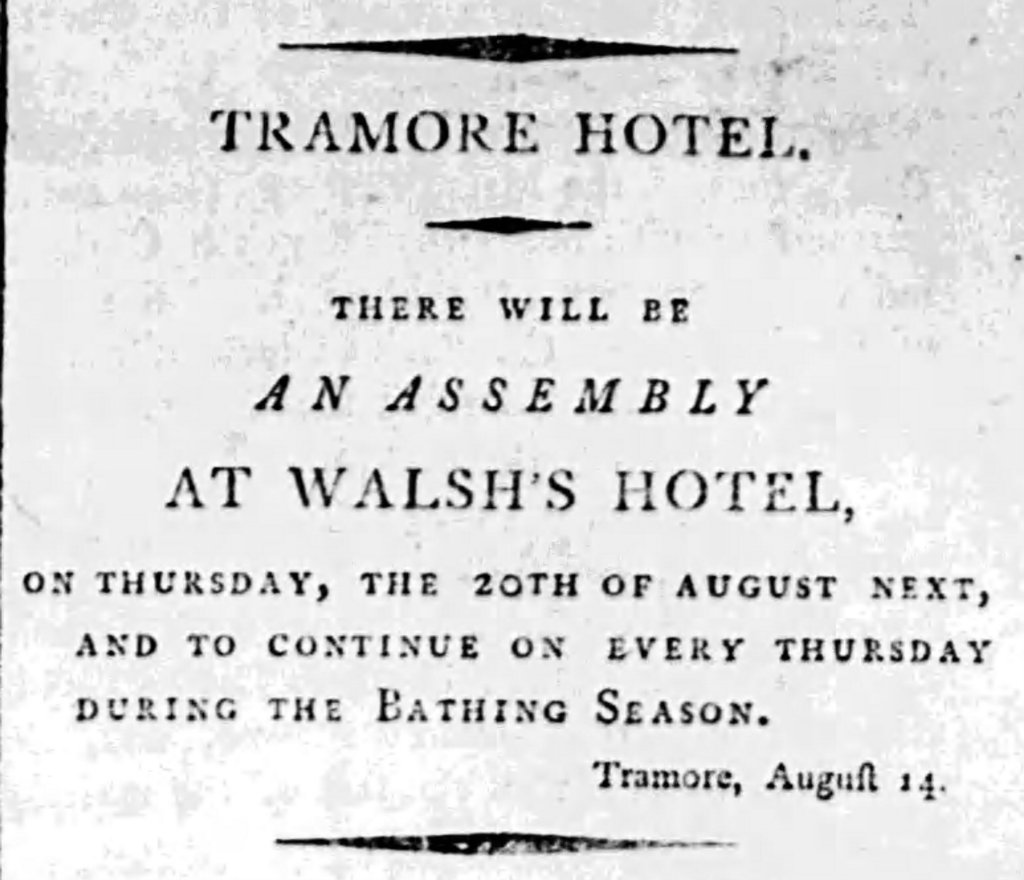
Seven years later, on 1 June 1801, John, advertised the Tramore Hotel, announcing that Mary Coghlan’s Hotel was ready for the reception of company. This indicates that the hotel continued to flourish under the new management.7 Again, on 14 August 1801, he advertised a series of assemblies in the Tramore Hotel, further enhancing the venue’s reputation as a social hub.8
On 15 March 1802, Patrick Power, acting as the executor of the will of his father, the late Nicholas Power of Ballinakill, advertised several houses and lots in Tramore ‘to be let’ for building, ‘commencing with Mrs. Coghlan’s House and Concerns from thence to Priest Lane.’ Patrick was the grandson of Bartholomew Rivers, whose concerns in Tramore had avoided being auctioned off by being bought out by his son-in-law, Nicholas. Fortunately, Mary was able to secure the lease to the property, allowing her business to continue thriving in the following years.9

By the summer of 1807, Walsh’s Tramore Hotel had taken over the staging of horse racing balls and began to be referred to as the Great Hotel. While Coghlan’s was also still in business, its opening for that year was advertised in the Waterford Mail on 23 May. In June of the same year, we learn that the Waterford to Tramore coach, known as the ‘Sociable,’ made its final stop outside of Coghlan’s Hotel, reinforcing its status and importance in the local community.10
At the ripe old age of seventy-one, Mary was again party to a deed. On 9 June 1809, Patrick Power of Tybroughney in County Kilkenny leased to her a ‘dwelling house, back house, stable yard and plot of ground in the rear thereof also classed as a garden’ at the yearly rent of twenty-one pounds, one shilling, and four pence. Mary consented that ‘all buildings made or to be made on said premises should be roofed with proper and right timber and covered with slates in the usual and customary way within the space of seven years or in default thereof to pay the additional yearly rent of five pounds.’11 This Patrick Power was the son and heir of Nicholas Power of Ballinakill and the grandson of Bartholomew Rivers, whose concerns in Tramore had cleverly avoided being auctioned off.
This late in her life, Mary seems to be a little old to have leased new premises, and this deed may in fact represent the releasing of her original hotel. This new premises was ‘nearing and bounding’ on the north by a part of Mr. Edward Lee’s concerns, on the east by John Maher’s dwelling house and back houses, on the west by the main road from Waterford to Tramore, and on the south by the main road, a street leading from said concern to the strand. This appears to be the location of what is now O’Neil’s pub, reflecting her distinctive legacy throughout the area. It would make sense for the coach travelling back and forth along the Old Waterford Road to stop there rather than continuing down the Main Street.
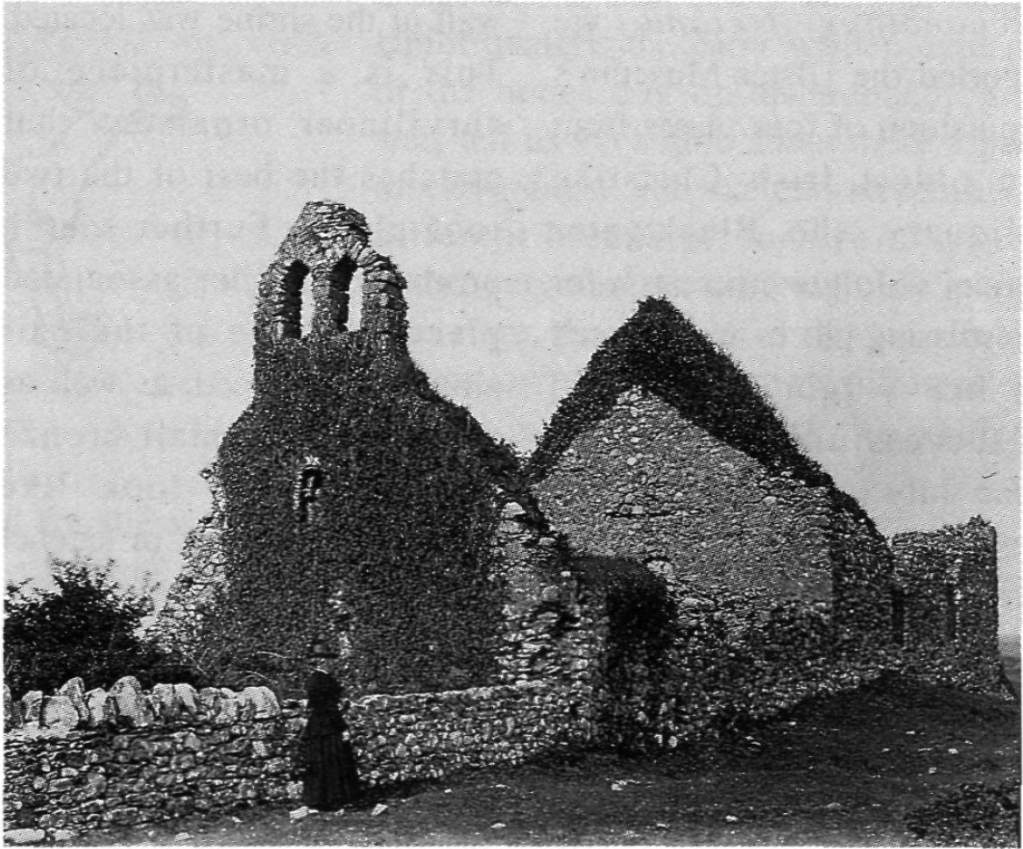
Mary died on the 22nd of April 1810, aged 72, after a career as a proprietress spanning forty-six years, and is buried alongside her husband Thomas in Drumcannon graveyard. The family memorial stone reads:
Here lieth the body of Thomas Coghlan who died the 21st day of December 1769 aged 40 years. Also, of Michael Coghlan his son who died the 21st of December 1790 aged 21. And Mary Coghlan of Tramore, wife of the said Thomas, who died the 22nd of April 1810 aged 72. Also, the body of John Walsh Esquire of Tramore who died the 10th July 1816 aged 43 years.13
Mary’s will was proved in 1814, and no doubt her influence and legacy continued to resonate within the community long after her death. John Walsh is noted for helping the victims of the Sea Horse in 1816 by supplying them with bottles of spirits; however, he passed away in the Summer of that year, leaving Catherine as the sole proprietress of the hotel.
- Finn’s Leinster Journal, 1 May 1790. ↩︎
- same. ↩︎
- Deed of Lease between Bartholomew Rivers etc. and Mary Coghlan, Registry of Deeds, D 304522. ↩︎
- The Waterford Herald, Tuesday 6 August 1793. ↩︎
- The Waterford Herald, Saturday 24 August 1793. ↩︎
- Deed of Assignment between Mary Coghlan and John Walsh, Registry of Deeds, D 201310 ↩︎
- The Waterford Mirror, 1 June 1801. ↩︎
- The Waterford Mirror, 15 August 1801. ↩︎
- The Waterford Mirror, 15 March 1802. ↩︎
- The Waterford Mirror, 24 June 1807. ↩︎
- Deed of Lease between Patrick Power and Mary Coghlan, Registry of Deeds, D 424610. ↩︎
- Michael Moore, Church Mystery Solved, Archaeology Ireland, Vol. 8, No. 3, p. 18. ↩︎
- Julian Walton, Monumental inscriptions at Drumcannon, Co. Waterford, Decies 45, page 55. ↩︎

 Tramore of Yore
Leave a comment